Last reviewed: 9 September 2026. All fee and processing information verified against indianvisaonline.gov.in (portal published 19 August 2026, managed by the Bureau of Immigration, Ministry of Home Affairs, designed by NIC).
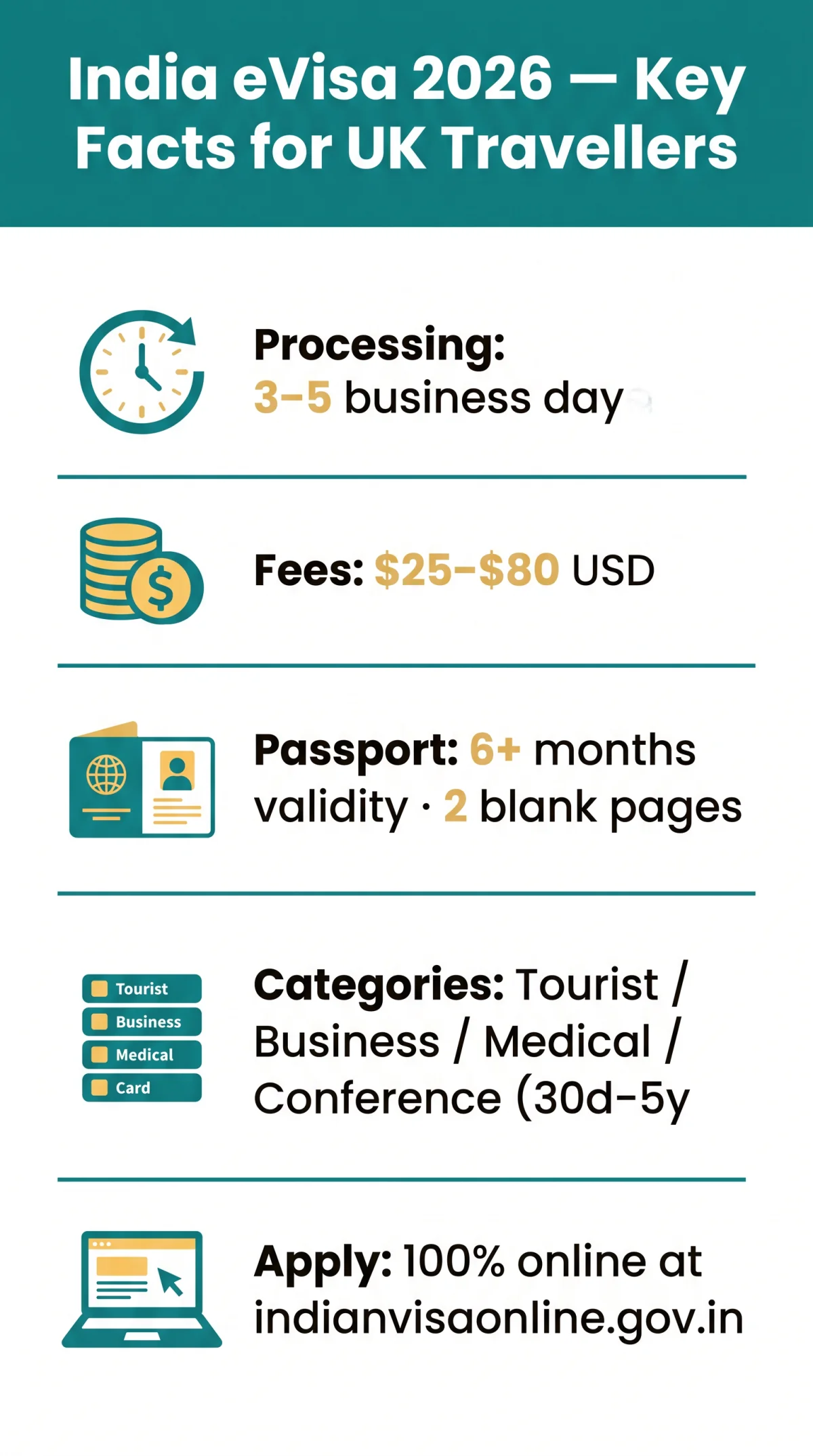
UK citizens can apply for the eVisa India entirely online at indianvisaonline.gov.in, with no embassy visit required. Processing takes 3 to 5 business days and costs $25 to $80 USD depending on category. A valid passport with at least 6 months remaining validity and 2 blank pages is mandatory.
What Is the India eVisa and How Does It Work?
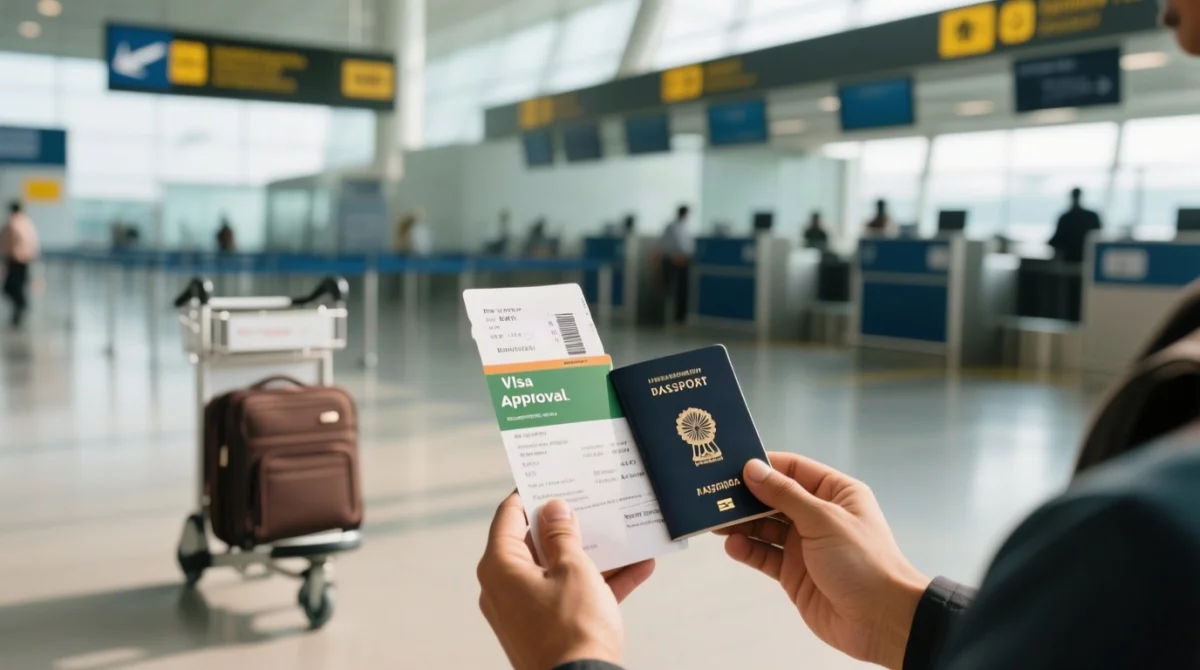
The India eVisa is an online travel authorisation issued by the Bureau of Immigration, Ministry of Home Affairs, obtained exclusively at indianvisaonline.gov.in – no embassy visit required. It replaces the traditional sticker visa for eligible UK travellers and must be obtained before travel.
The eVisa India is not a Visa on Arrival, which is restricted to nationals of Japan, South Korea, and the UAE (UAE nationals must have previously held an e-Visa or regular visa). Visa on Arrival is available only at Delhi, Mumbai, Chennai, Kolkata, Bengaluru, and Hyderabad airports. The India eVisa is available in five categories: e-Tourist (30-day, 1-year, 5-year), e-Business, e-Medical, e-Medical Attendant, and e-Conference.
India eVisa Eligibility – Can UK Citizens Apply?
UK passport holders are India eVisa-eligible for tourism, business, medical treatment, and conferences. UK travellers seeking employment, journalism, or long-term study exceeding 6 months must obtain a regular paper visa from an Indian Mission or Post instead. For a full breakdown of who qualifies, see our complete eligibility criteria for UK travellers.
OCI and eOCI card holders may enter India using their card together with a valid passport – no separate eVisa India is required for Persons of Indian Origin in eligible categories.
Passport Requirements – Minimum Validity and Blank Page Rules
The eVisa India requires an ordinary passport valid for at least 6 months from the date of arrival in India, with 2 completely blank pages. Diplomatic and official passport holders must apply for a traditional embassy visa. Ensure the name on the application matches the passport exactly; renew the passport first if it fails either criterion.
Types of India eVisa – Tourist, Business, Medical, and Conference Explained
The India eVisa is issued in four categories – e-Tourist (30-day, 1-year, 5-year), e-Business, e-Medical, and e-Conference – each with distinct validity, entry limits, and required documents. An e-Medical Attendant subcategory is available for companions of medical patients.
| Category | Validity | Entries | Max Stay | Key Additional Documents |
|---|---|---|---|---|
| e-Tourist (30-day) | 30 days from arrival | Double | 30 days | Flight itinerary, hotel booking |
| e-Tourist (1-year) | 1 year from issue | Multiple | 90 days per visit | Flight itinerary, hotel booking |
| e-Tourist (5-year) | 5 years from issue | Multiple | 90 days per visit | Flight itinerary, hotel booking |
| e-Business | 1 or 5 years | Multiple | 180 days per visit | Business card, invitation letter |
| e-Medical | 60 days from arrival | Triple | 60 days | Hospital appointment letter (India) |
| e-Conference | 30 days from arrival | Single | 30 days | Government/ministry invitation |
India eVisa Application Process – Step by Step for UK Travellers
Register at indianvisaonline.gov.in
Create an account using a valid email address.
Select your eVisa category and complete the form
Choose your eVisa category (e-Tourist, e-Business, e-Medical, or e-Conference) and nationality, then complete the online application form with personal details, passport information, travel plans, and employment data.
Upload your digital photo and passport bio-page scan
Ensure both meet the technical specifications below.
Pay the visa application fee online
Pay via Visa, MasterCard, or PayPal (a bank processing fee of ~2-3% may apply).
Save your Application ID
Save it immediately after submission.
Track your application status
Use the Application ID on the portal to check progress.
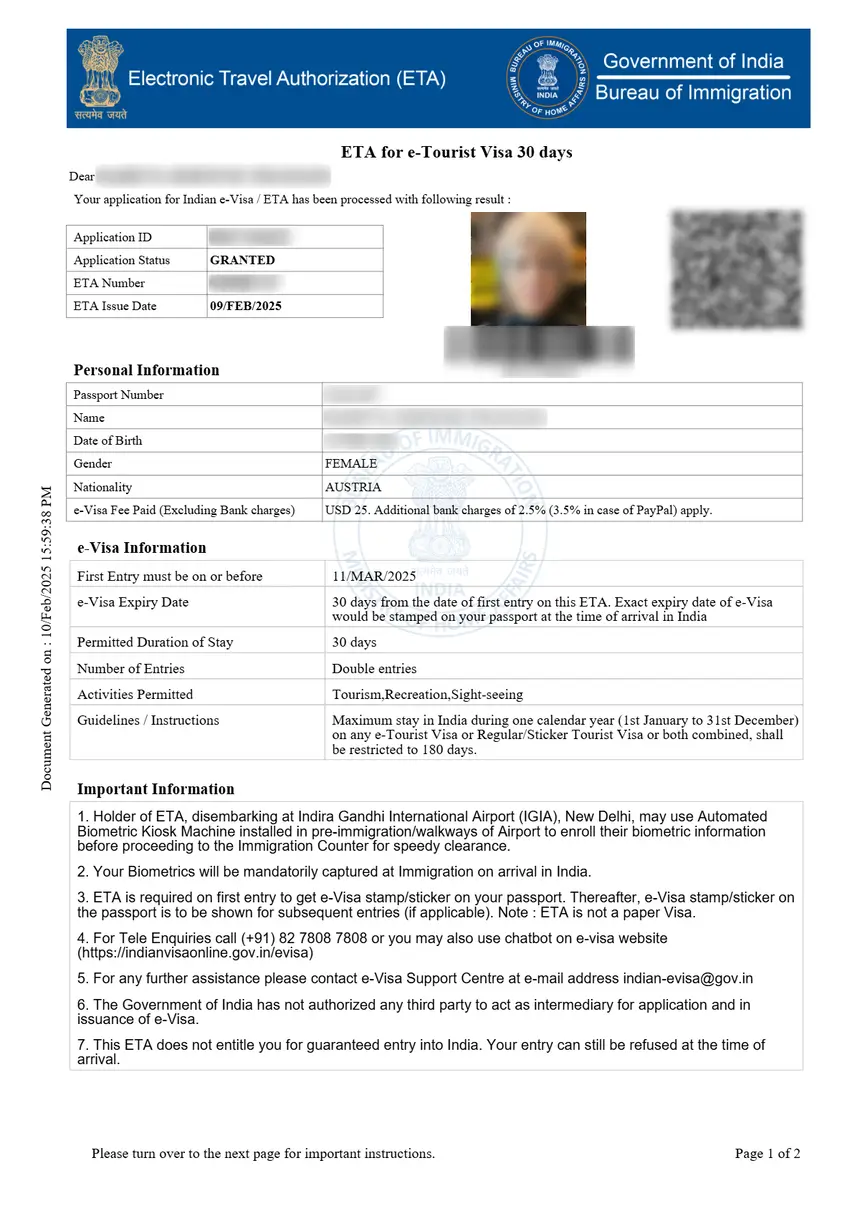
Receive your approved ETA by email
The Electronic Travel Authorisation (ETA) arrives within 3-5 business days.
Print at least 2 colour copies
Print the granted ETA for travel.
Present the printed ETA
Show it at airline check-in and at the Indian immigration counter upon arrival.
Digital Document Upload Specifications
The eVisa India portal rejects uploads that fail technical requirements. Photo: JPEG format, file size 10 KB-300 KB, white or light-coloured background, face covering 50-60% of the frame, recent (within 6 months), no glasses, no headwear (unless religious). For detailed guidance on dimensions and background, see our eVisa India photo requirements guide. Passport bio-page scan: JPEG or PDF, same file-size range, all four corners visible, all text legible, no reflections.
How to Track Your eVisa Application Status and Print Your ETA
Enter your Application ID in the “Visa Status” enquiry tool on indianvisaonline.gov.in. Statuses display as Received, Under Processing, Granted, or Rejected. Once granted, the ETA is downloadable from the portal and sent to your registered email. Check your spam folder if the ETA does not arrive. Print two colour copies and carry both with your passport.
India eVisa Fees for UK Travellers – 2026 Costs and Payment Methods
The India eVisa fees for UK citizens range from $25 USD (30-day e-Tourist, e-Medical, or e-Conference) to $80 USD (5-year e-Tourist or e-Business). Every visa application fee is non-refundable, even if the application is rejected. For a full breakdown with no hidden costs, see our complete eVisa India fee guide.
| Category | Validity | Fee (USD) | Approx. GBP* |
|---|---|---|---|
| e-Tourist (30-day) | 30 days | ~$25 | ~£20 |
| e-Tourist (1-year) | 1 year | ~$40 | ~£32 |
| e-Tourist (5-year) | 5 years | ~$80 | ~£64 |
| e-Business | 1 or 5 years | ~$80 | ~£64 |
| e-Medical | 60 days | ~$25 | ~£20 |
| e-Conference | 30 days | ~$25 | ~£20 |
*GBP figures are approximate and depend on the bank exchange rate at time of payment.
Fees are paid at indianvisaonline.gov.in via Visa, MasterCard, or PayPal (bank processing fee ~2-3% may apply). Charges are in USD, converted to GBP by your card issuer.
India eVisa Processing Time – How Long Does It Take in 2026?
Standard eVisa India processing takes 3-5 business days (often within 72 hours). No fast-track exists – submit 7-14 days before departure. For a detailed look at what influences timelines, read our guide on how long it takes to process an Indian eVisa. The Government of India does not authorise any agent or intermediary to offer emergency or express processing for the India eVisa.
Common India eVisa Application Mistakes UK Travellers Must Avoid
The most common India eVisa rejection causes are passport number errors, name mismatches, poor photo quality, and applying for the wrong visa category.
- Incorrect passport number or expiry date entered on the form
- Name mismatch between passport and application (e.g., missing middle name)
- Low-quality photo (wrong background, face too small, file out of spec)
- Passport bio-page scan cropped or unreadable
- Wrong eVisa category selected for the intended purpose of travel
- Wrong port of arrival entered on the application
- Failure to print the ETA before travel
- Using unofficial third-party websites instead of indianvisaonline.gov.in
- Applying too close to the travel date
- Passport with less than 6 months validity from the date of arrival in India
India eVisa Arrival Requirements – e-Arrival Card, Self-Declaration & Biometrics
After obtaining an eVisa India, travellers must complete the mandatory e-Arrival Card online within 72 hours before landing – it is not a visa replacement. The e-Arrival Card is required for all foreign nationals and OCI/eOCI card holders, and must be submitted before reaching immigration counters. Submit via boi.gov.in, indianvisaonline.gov.in/earrival/, or the ‘Indian Visa Su-Swagatam’ mobile app. No agent is authorised to charge fees for this service.
The Air Suvidha Self-Declaration Form is mandatory for all international passengers. Submit before reaching arrival immigration counters at airsuvidha.civilaviation.gov.in. Fields include travel history, health symptoms, vaccination status, and contact information. Carry confirmation (digital or printed) for health screening.
India eVisa vs Traditional Visa – Which One Should UK Travellers Choose?
The eVisa India processes in 3-5 business days at $25-$80 USD, while a traditional embassy visa takes 5-15 business days at £100-£200+ GBP – but only the traditional visa allows extensions and land border entry. For a side-by-side breakdown, see our comparison of eVisa and regular visa for India.
| Factor | India eVisa | Traditional Visa |
|---|---|---|
| Application method | Online (100%) | In-person at embassy/VFS |
| Processing time | 3-5 business days | 5-15 business days |
| Cost (UK citizens) | $25-$80 USD | £100-£200+ GBP |
| Validity | 30 days – 5 years | Varies (up to 10 years) |
| Max stay per visit | 30-180 days | Up to 180 days |
| Extendable in India | No | Yes (some categories) |
| Convertible in India | No | Case-by-case |
| Land border entry | No | Yes |
Important Restriction – The eVisa Cannot Be Extended or Converted
A granted India eVisa cannot be extended, renewed, or converted to any other visa category while inside India. Overstaying carries fines, detention, deportation, and potential travel bans. UK travellers needing a longer stay must apply for a traditional visa before departure.
Approved Ports of Entry – Where Can You Use Your India eVisa?
The eVisa India is accepted at 32 designated airports and 6 seaports only. Land border crossings from Nepal, Bangladesh, or Pakistan require a traditional visa. For the full list of entry points, see our guide on designated airports, seaports and land borders for eVisa holders.
- North India: Delhi (DEL), Amritsar (ATQ), Lucknow (LKO), Jaipur (JAI)
- South India: Bengaluru (BLR), Chennai (MAA), Hyderabad (HYD), Kochi (COK), Thiruvananthapuram (TRV), Tiruchirappalli (TRZ), Goa (GOI)
- East India: Kolkata (CCU), Visakhapatnam (VTZ)
- West India: Mumbai (BOM), Ahmedabad (AMD)
- Designated seaports: Mumbai, Goa, Mangalore, Cochin, Chennai
What to Expect at Indian Immigration – Arrival Procedures for eVisa Holders
The eVisa India requires holders to follow a specific arrival sequence at designated ports of entry, beginning at UK airline check-in and ending at Indian customs.
Present your printed ETA at UK airport check-in
Show at least 2 colour copies alongside your passport.
Proceed to the eVisa immigration counter
Use the separate eVisa lane, distinct from regular visa lanes.
Present your documents
Provide printed ETA, valid passport (open to bio page), and return ticket if requested.
Complete mandatory biometric enrollment
10-finger fingerprint scan and facial photograph, typically taking 2-3 minutes.
Answer officer questions
Regarding travel purpose, duration of stay, and accommodation address.
Collect baggage and proceed through customs
Use the green channel if carrying nothing declarable.
Biometric Enrollment at the Port of Entry
First-time eVisa India arrivals must complete an all-10-finger fingerprint scan and a facial photograph at immigration, typically taking 2-3 minutes. Biometric data is stored for future visits; returning travellers may skip this step.
Health and Yellow Fever Vaccination Requirements
eVisa India holders arriving from or transiting Yellow Fever endemic zones (parts of Africa and South America) must carry a vaccination certificate issued at least 10 days before arrival. Without it, quarantine of up to 6 days may apply. UK travellers not arriving from endemic zones require no specific vaccination as of 2026. COVID-19 vaccination is no longer mandatory. Consult a GP 6-8 weeks before travel regarding Hepatitis A and Typhoid recommendations.
India eVisa Fraud Advisory – How to Spot Scams and Apply Safely
The Indian government authorises no third-party India eVisa agents – only indianvisaonline.gov.in processes legitimate applications. Applications submitted elsewhere risk inflated charges and personal data misuse. UK travellers who encounter fraudulent eVisa India sites should report the incident to their bank and to Action Fraud (UK).
India eVisa Helpline and Support Contacts
eVisa India support is available 24/7 at +91-11-24300666 or +91-8278087808 and via email at [email protected]. The British High Commission does not handle eVisa queries.
| Contact Type | Details |
|---|---|
| Helpline (24/7 phone) | +91-11-24300666 and +91-8278087808 |
| Email support | [email protected] |
| British High Commission | Does NOT process India eVisa queries |
A refused application cannot be overturned by the helpline – applicants must reapply and pay the visa application fee again.
Frequently Asked Questions About the eVisa India
How do I apply for an India eVisa from the UK?
Apply at indianvisaonline.gov.in: register, select your visa type, complete the form, upload photo and passport scan, pay the fee, and print the granted ETA. The entire process is online with no embassy visit.
How much does the India eVisa cost for UK citizens in 2026?
Fees range from $25 USD (30-day tourist, medical, conference) to $80 USD (5-year tourist, business). All fees are non-refundable, even if rejected.
How long does the India eVisa take to process?
Standard processing takes 3-5 business days (often within 72 hours). Submit at least 7-14 days before travel; no fast-track option exists.
Can I enter India through any airport with an eVisa?
No. The eVisa India is accepted only at 32 designated airports and 6 seaports. Land border crossings require a traditional visa.
What documents do I need for the India eVisa?
A valid passport (6 months validity, 2 blank pages), a recent JPEG photo (white background, 10-300 KB), and a passport bio-page scan (JPEG or PDF, 10-300 KB). Category-specific documents may also apply.
Can I extend my India eVisa while in India?
No. The eVisa cannot be extended, renewed, or converted. Overstaying carries fines, detention, deportation, and potential travel bans.
What is the India e-Arrival Card?
A mandatory online form for foreign nationals and OCI/eOCI holders, completed within 72 hours before arrival via indianvisaonline.gov.in/earrival/ or the Su-Swagatam app. It is separate from the eVisa.
Do I need biometrics at Indian immigration with an eVisa?
Yes. First-time arrivals must complete a 10-finger fingerprint scan and facial photograph (2-3 minutes). Returning visitors with stored biometric data may skip this step.
What happens if my India eVisa is rejected?
You can reapply immediately but must pay the non-refundable fee again. Common causes include photo quality, passport validity, and data errors.
Is travel insurance required for the India eVisa?
Not legally required, but strongly recommended. Cover should include medical expenses, trip cancellation, and repatriation.
This is an independent guide for informational purposes only. For official decisions, always refer to indianvisaonline.gov.in.