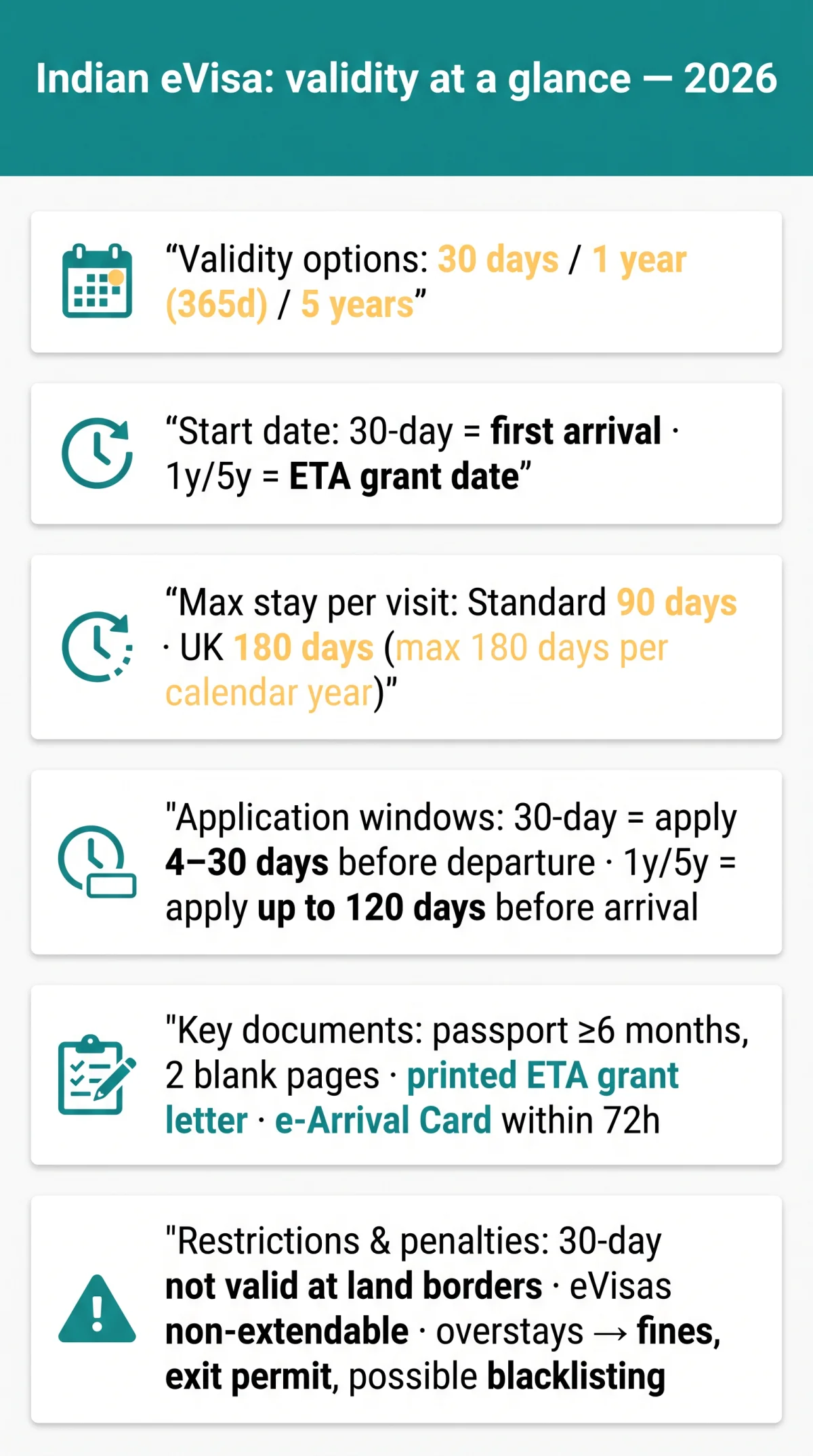
What is the validity of an Indian eVisa? An Indian eVisa is valid for 30 days, 1 year, or 5 years, with UK citizens permitted up to 180 days per visit versus 90 days for most nationalities. The 1-year and 5-year validity clocks start from the ETA grant date, not the travel date. The 30-day Indian eVisa validity starts from the date of first arrival in India. All three types allow multiple entries. Last updated: 9 September 2026.
What Does Indian eVisa Validity Actually Mean?
Indian eVisa validity is the entry window, not a stay permit. The 1-year and 5-year clocks start from the ETA approval date, not departure.
Indian eVisa validity has two distinct concepts: validity period (the entry window during which the Electronic Travel Authorization remains active) and maximum stay per visit (days allowed inside India per entry).
The 30-day e-Tourist Visa counts from the date of first arrival in India. The 1-year (365-day) and 5-year e-Tourist Visas count from the date of grant of ETA (approval date, not travel date).
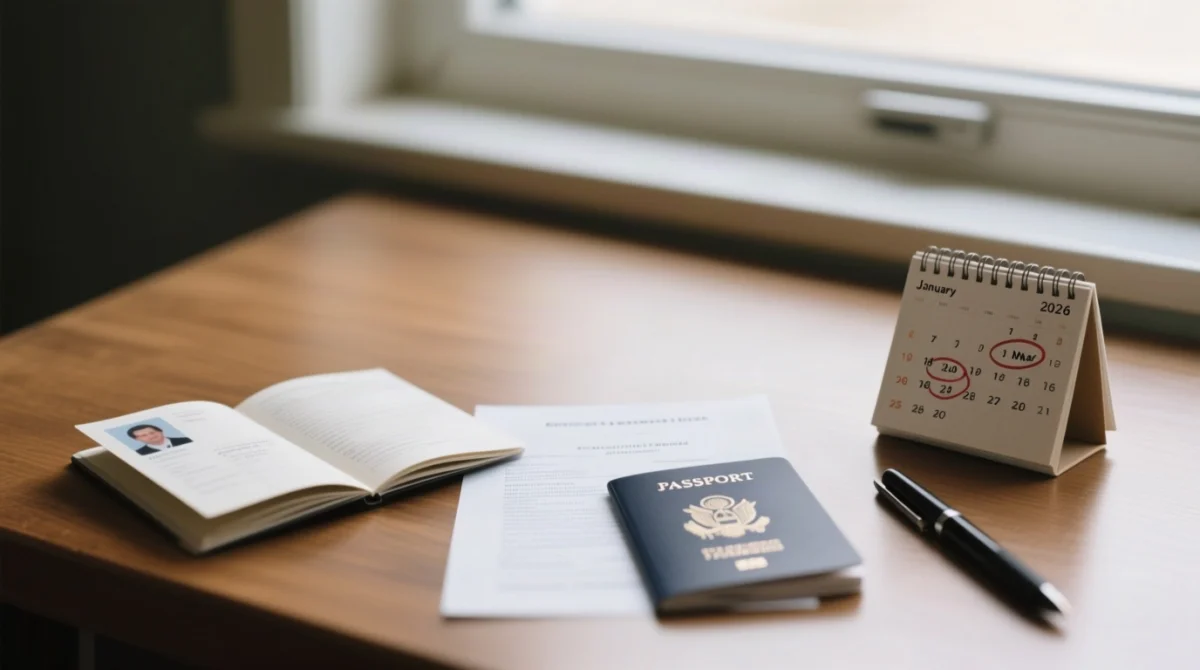
Worked example: approved for a 1-year Indian eVisa on 1 January 2026, travel 1 March 2026. Two months of validity consumed before arrival; only 10 months remain.
The Three Indian eVisa Validity Periods Compared
Three e-Tourist Visa tiers exist: 30-day (from first arrival), 1-year and 5-year (both from grant of ETA). The 30-day Indian eVisa is non-extendable and non-convertible, and not valid for entry through Land Immigration Check Posts. All three tiers permit multiple entries. For current fee amounts, check indianvisaonline.gov.in.
| Validity | Starts From | Entry Type | Max Stay (Standard) | Max Stay (UK) |
|---|---|---|---|---|
| 30 days | Date of first arrival | Multiple entries | 30 days | 30 days |
| 1 year (365 days) | Grant of ETA | Multiple entries | 90 days per visit | 180 days per visit |
| 5 years | Grant of ETA | Multiple entries | 90 days per visit | 180 days per visit |
Indian eVisa Rules for UK Citizens in 2026
UK citizens get 180 days per visit on 1-year and 5-year Indian eVisas (vs. 90 days for most nationalities), but cumulative time cannot exceed 180 days per calendar year.
The Indian eVisa validity framework grants British passport holders a maximum continuous stay of 180 days per visit on 1-year and 5-year e-Tourist Visas. Cumulative cap: max 180 days per calendar year across all entries. E.g. entry 1 October 2026, stay until 31 March 2027. No second entry that calendar year is allowed.
UK applicants must hold a passport valid for at least 6 months from the date of arrival, with a minimum of 2 blank pages. A printed copy of the ETA grant letter is required at airline check-in and immigration inspection upon arrival in India. For UK government travel advice, refer to gov.uk/foreign-travel-advice/india.
Application Timing Windows Explained
The Indian eVisa validity framework specifies strict submission windows: the 30-day Indian eVisa must be requested between 30 days and at least 4 days before departure, while the 1-year and 5-year categories accept applications up to 120 days in advance (the 120-day arrival window) of the planned arrival date.
Standard processing takes 3 to 6 business days; an urgent service completes review in 1 to 3 days with additional charges. Applying too early risks ETA expiry; too late risks non-approval. Based on our editorial team’s experience applying for Indian eVisas in 2026, we recommend applying at least 10 days before departure to allow buffer for processing delays.
Worked example for a UK traveller departing 1 November 2026: the 30-day Indian eVisa window runs from 2 October to 28 October 2026. For the 1-year or 5-year Indian eVisa, applications may be submitted from 3 July 2026 onward. Current fees and the application portal are available at indianvisaonline.gov.in.
Visual timeline for 30-day Indian eVisa:
Earliest you can apply
30 days before departure
Recommended window
10 to 14 days before
Latest safe date
4 days before
Departure date
Travel to India
Stay clock starts
First arrival in India
Visual timeline for 1-year / 5-year Indian eVisa:
Earliest you can apply
120 days before arrival
Recommended window
30 to 60 days before
Latest safe date
7 days before
Departure date
Travel to India
Stay clock starts
Grant of ETA date
Which Indian eVisa Should You Choose?
A single two-week trip favours the 30-day Indian eVisa; two or more annual trips make the 1-year or 5-year Indian eVisa more cost-effective. Longer validity periods require a higher initial fee but reduce long-term expenses for repeat travellers. Verify current pricing on the indianvisaonline.gov.in portal.
| Travel Scenario | Recommended eVisa | Rationale |
|---|---|---|
| One 2-week holiday per year | 30-day eVisa | Valid for 30 days from first arrival; lowest upfront fee for a single entry window. |
| Two trips within 12 months | 1-year eVisa | Valid for 365 days from grant of ETA; allows multiple entries with up to 180 days per visit for UK citizens. |
| Regular visits over 5 years | 5-year eVisa | Valid for 5 years from grant of ETA; most cost-effective for frequent travellers, permitting multiple entries. |
Where Can You Enter India with an eVisa? Designated Ports of Entry
Indian eVisas are accepted at 28+ designated international airports and select seaports; the 30-day e-Tourist Visa cannot be used at land border crossings or Land Immigration Check Posts.
Key UK routes include Heathrow to Delhi (Indira Gandhi International), Heathrow to Mumbai (Chhatrapati Shivaji Maharaj), and Gatwick to Bangalore (Kempegowda International). Visa on Arrival is available only for Japan, South Korea, and UAE nationals at Delhi, Mumbai, Chennai, Kolkata, Bengaluru, and Hyderabad airports (source: indianvisaonline.gov.in).
Before travel, UK citizens must also complete the e-Arrival Card, a free arrival information submission (not a visa) available at indianvisaonline.gov.in/earrival or via the Indian Visa Su-Swagatam mobile app, within 72 hours before arrival in India.
Important Restrictions and Overstay Consequences
Indian eVisas are strictly non-extendable and non-convertible. Overstaying by even one day triggers daily fines, mandatory exit permits, and potential blacklisting.
Overstaying an Indian eVisa triggers formal procedures under the Foreigners Act, 1946. Penalties include daily financial fines, a mandatory exit permit (REP) from the Foreigners Regional Registration Office (FRRO/FRO), and potential blacklisting resulting in future visa refusal. FRRO/FRO registration is mandatory if a continuous stay exceeds 180 days, within 2 weeks after the 180-day period expires.
Indian eVisas do not cover entry into Protected/Restricted/Cantonment Areas, which require separate RAP/PAP permits. Key restricted regions include parts of Arunachal Pradesh, Sikkim, Uttarakhand, Andaman and Nicobar Islands (restricted tribes), Manipur, Mizoram, and Nagaland.
Disclaimer: This article is for informational purposes only and does not constitute legal advice. Always verify the latest rules on the official Indian visa portal (indianvisaonline.gov.in) before applying.
FAQ: Indian eVisa Validity in 2026
What is the validity of an Indian eVisa?
An Indian eVisa is valid for three periods: 30 days from first arrival, 1 year from the grant of ETA, or 5 years from the grant of ETA. UK citizens can stay up to 180 days per visit, while most other nationalities have a 90-day limit. All types allow multiple entries.
How long can I stay in India on a 30-day eVisa?
You can stay for a maximum of 30 days per visit on a 30-day Indian eVisa. This Indian eVisa is non-extendable and non-convertible, and it is not valid for entry through Land Immigration Check Posts.
When does the Indian eVisa validity start?
For a 30-day Indian eVisa, validity starts from the date of first arrival in India. For the 1-year and 5-year Indian eVisa, the validity clock starts from the date of grant of ETA (approval date). If approved on 1 January 2026 but you travel on 1 March 2026, you lose two months of validity.
How long does Indian eVisa processing take?
Standard processing time for an Indian eVisa is 3 to 6 business days. An urgent Indian eVisa service is available, processing in 1 to 3 days with additional charges.
Can an Indian eVisa be extended?
No. An Indian eVisa is strictly non-extendable and non-convertible. You must leave India before your maximum stay limit expires. If you wish to stay longer or change your visa type, you must apply for a regular visa through an Indian Mission.
Do I need to print my Indian eVisa?
Yes. You must carry a printed copy of the ETA grant letter for your Indian eVisa. You will need to present this printed copy at airline check-in and to immigration officials upon your arrival in India.
What happens if I overstay my Indian eVisa?
Overstaying an Indian eVisa by even one day triggers formal procedures, including daily fines, a mandatory exit permit (REP) from FRRO/FRO, potential blacklisting, and future visa refusal. Serious overstays can lead to criminal prosecution under the Foreigners Act, 1946.
Can I enter on a new passport if my Indian eVisa is on the old one?
Yes. If your Indian eVisa was issued for your old passport, you can still enter India by carrying both the old passport (containing the valid eVisa) and your new passport. Ensure the biographical details match exactly on both documents.
Is the Indian eVisa valid at land border crossings?
No. The 30-day Indian eVisa is not valid for entry through Land Immigration Check Posts. Indian eVisas are only accepted at 28+ designated international airports and select seaports. You must arrive through these designated ports of entry.
How many times can I enter India on a 1-year or 5-year eVisa?
Both the 1-year and 5-year Indian eVisa allow multiple entries. UK citizens can stay up to 180 days per visit, subject to an annual cumulative cap of 180 days per calendar year. Most other nationalities have a maximum stay of 90 days per visit.