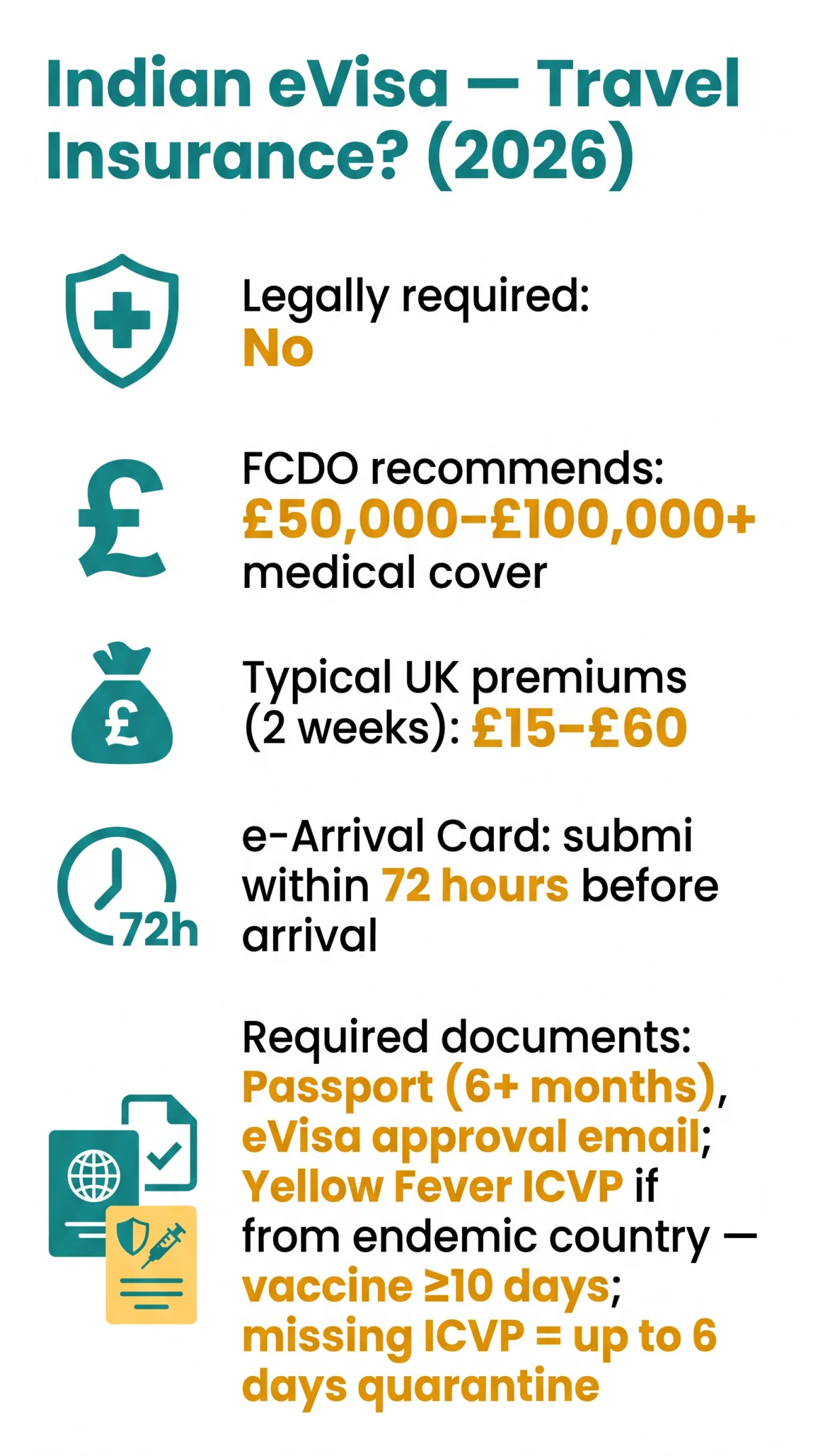
No, travel insurance is not legally mandatory for an Indian eVisa in 2026. The application portal indianvisaonline.gov.in does not list insurance among required documents. However, FCDO strongly recommends comprehensive medical cover of £50,000 to £100,000+, as NHS provides zero coverage in India and private hospital bills can exceed £10,000.
The Indian eVisa requires only a valid passport, but without insurance you risk financial exposure. Emergency evacuation is essential; typical UK premiums for two weeks are £15 to £60.
Beyond insurance, health requirements for the Indian eVisa depend on your itinerary. Yellow fever vaccination rules apply to arrivals from WHO-listed endemic countries, while the mandatory e-Arrival Card must be submitted within 72 hours before your arrival in India.
Is Travel Insurance Mandatory for an Indian eVisa?
Travel insurance is not a legal requirement for the Indian eVisa. The portal indianvisaonline.gov.in lists no insurance document among required materials, and Indian immigration officers do not verify travel insurance at eVisa entry points in 2026. The Indian eVisa is issued by the Bureau of Immigration, Ministry of Home Affairs, via a fully online process with standard processing time for an Indian eVisa of 72 hours (3 business days). Entry is permitted at 28 designated airports and 5 seaports. The Government of India does not authorise any agent or intermediary to charge fees for eVisas.
Despite no mandate, FCDO recommends cover; NHS covers nothing in India, private bills can exceed £10,000, and UK premiums range £15 to £60.
- Emergency medical evacuation and repatriation to the UK
- Minimum £50,000 medical expenses (£100,000+ for comprehensive cover)
- Trip cancellation coverage
- COVID-19 hospitalisation coverage
- Policy validity aligned with your Indian eVisa duration
- UK premiums range £15 to £60
- Exclusions for pre-existing conditions
- Exclusions for high-risk activities such as trekking or motorbiking
| Tier | Medical cover | Key features | UK premium |
|---|---|---|---|
| Basic | £25,000 | Limited medical only | £12-£25 |
| Standard | £50,000+ | Includes repatriation | £25-£45 |
| Comprehensive | £100,000+ | Cancellation + COVID-19 | £40-£65 |
Yellow Fever Vaccination Rules and Quarantine Consequences
Travellers from 40+ WHO-listed endemic countries must present a physical International Certificate of Vaccination or Prophylaxis (ICVP) at Indian ports of entry. Digital PDF copies are not universally accepted; the physical WHO Yellow Card booklet is the required format for Indian eVisa holders arriving from affected regions.
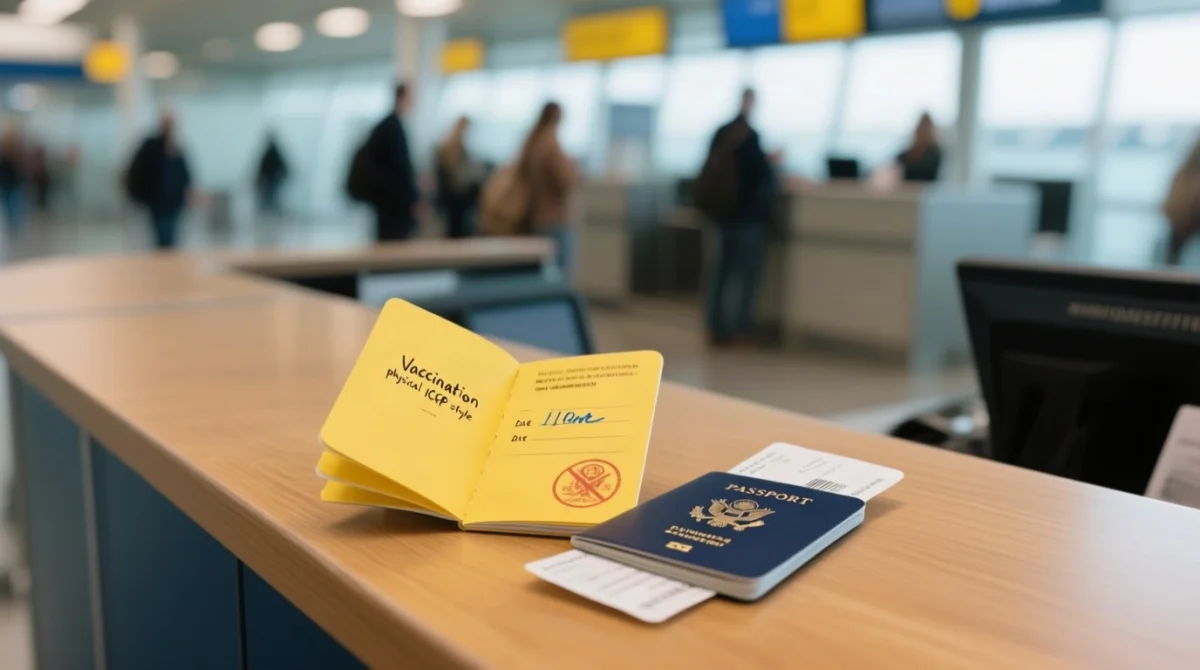
The vaccine must be given at least 10 days before entry into India; one dose is valid for life. UK residents can obtain the certificate through designated Yellow Fever Vaccination Centres listed via NaTHNaC and TravelHealthPro.
The transit rule also applies: if connecting through an endemic country (e.g., Nairobi, São Paulo), the ICVP is mandatory for Indian eVisa travellers unless your transit remains strictly airside.
Quarantine penalty: Arriving without a valid ICVP from an endemic country triggers up to 6 days of mandatory isolation at a designated facility. The traveller bears all costs, and no access to private healthcare is permitted during the quarantine period.
COVID-19 Entry Rules and Recommended Vaccinations for India (2026)
As of September 2026, India no longer requires RT-PCR tests or COVID-19 vaccination proof for Indian eVisa holders. The pandemic-era Air Suvidha Self-Declaration Form has been discontinued and replaced by the e-Arrival Card system.
The Indian eVisa application process does not list COVID-19 or routine vaccinations among mandatory health requirements. However, NHS TravelHealthPro (Public Health England) recommends the following immunisations 6 to 8 weeks before departure:
- Hepatitis A – 2 doses; start 6-8 weeks before travel
- Typhoid – single injection or oral course
- Tetanus/Diphtheria – booster if >10 years since last dose
- Hepatitis B – 3-dose course (itinerary-dependent)
- Rabies – pre-exposure course advisable for rural travel
UK travellers can access these vaccinations through free NHS travel clinics or private providers such as Boots and Superdrug. Guidance is available via the NHS TravelHealthPro portal.
Pre-Arrival Health Formalities, Disease Risks and UK Government Guidance
All Indian eVisa holders must submit an e-Arrival Card within 72 hours before arrival in India via indianvisaonline.gov.in/earrival/ or boi.gov.in, or through the Indian Visa Su-Swagatam Mobile App. Required fields include passport details, flight information, health status declaration, and accommodation address. The e-Arrival Card is an arrival information form, not a visa, and non-compliance may cause immigration delays for Indian eVisa travellers.
Malaria and dengue risk areas include rural central and eastern India and Goa during monsoon season. Antimalarials are available free via an NHS GP prescription or privately for £15 to £30. Use DEET 50%+ repellent and treated mosquito nets.
Check FCDO travel advice at gov.uk/foreign-travel-advice/india before departure. FCDO advises against travel to parts of India including Jammu and Kashmir and Manipur.
Last verified: 9 September 2026. This article reflects Indian eVisa health rules as published on indianvisaonline.gov.in and FCDO travel advice as of that date. This website is an independent travel information portal and is not affiliated with the Government of India. Always verify requirements at indianvisaonline.gov.in before applying.
Indian eVisa Health and Vaccination Rules: FAQ
Do I need to carry my Yellow Fever vaccination booklet when entering India on an Indian eVisa?
Yes, a physical ICVP (Yellow Card) is required. Digital copies are not accepted at Indian ports of entry.
What happens if I arrive in India without a Yellow Fever certificate from an endemic country?
You face up to 6 days mandatory quarantine at a designated facility. Costs are borne by you, with no access to private healthcare during isolation.
Can I buy travel insurance after arriving in India with an Indian eVisa?
Most UK insurers require purchase before departure. Buy before you fly to ensure full coverage for your Indian eVisa journey.
Does India check travel insurance at the airport when I enter with an Indian eVisa?
No. Indian immigration does not verify travel insurance at eVisa entry points as of 2026. However, private hospital bills can exceed £10,000.
Are there any exemptions from travel insurance for an Indian eVisa?
There are no exemptions because travel insurance is not mandatory for any Indian eVisa applicant under Indian immigration law.
What documents do I need for Indian eVisa health requirements in 2026?
A valid passport (6+ months validity), your Indian eVisa approval email, and a submitted e-Arrival Card. A physical Yellow Fever ICVP is required only if arriving from an endemic country.
Is the Oral Polio Vaccine (OPV) required for UK travellers entering India?
OPV is mandatory only for travellers from polio-affected countries (Pakistan, Afghanistan, Nigeria). UK citizens are not directly affected.
What is the new rule for all foreigners going to India in 2026?
The e-Arrival Card is mandatory for all foreign nationals, including Indian eVisa holders, submitted via indianvisaonline.gov.in within 72 hours before arrival.
Does my UK NHS coverage work in Indian hospitals?
No. The NHS provides zero coverage outside the UK. All treatment in India must be paid out-of-pocket or claimed through travel insurance.
How long before my trip should I get vaccinated for India?
Routine vaccinations should be started 6 to 8 weeks before departure. Yellow fever vaccine requires at least 10 days before entry into India.