
This article compares eVisa India fees for UK, US, and Australian citizens across 30-day, 1-year, and 5-year tiers, including the 3% bank surcharge and true out-of-pocket costs based on Bureau of Immigration data. For British travellers, the 30-day e-Tourist Visa costs £25 during peak season (July to March) and £10 off-peak (April to June). The 1-year multiple-entry visa is £40, while the 5-year option costs £65. US and Australian citizens pay US$25, US$40, and US$80 for the 30-day, 1-year, and 5-year tiers respectively. All fees are processed in US dollars on the authorised portal and incur an automatic 3% bank gateway surcharge at checkout. Our analysis includes worked currency conversion examples showing the exact amount charged to UK and Australian cards for your 2026 travel planning.
What Is the India eVisa and Who Needs One?
The India eVisa comes in three validity tiers: 30-day double-entry, 1-year multiple-entry, and 5-year multiple-entry, all requiring a passport with at least 6 months validity from arrival. UK, US, and Australian passport holders are all eligible. The India eVisa is the most common category, though e-Business (1-year, multiple entry) and e-Medical (60-day, triple entry) alternatives exist. Processing time is 4 business days from submission. All eVisa India fee breakdown figures below are sourced from the Bureau of Immigration’s authorised portal and cross-checked on 1 June 2026.
eVisa India Fee Breakdown: 30-Day, 1-Year and 5-Year Costs for UK, US and Australia in 2026
Government India eVisa fees vary by nationality and validity tier, with UK, US, and Australian citizens facing nationality-based pricing plus a 3% bank gateway surcharge at checkout.
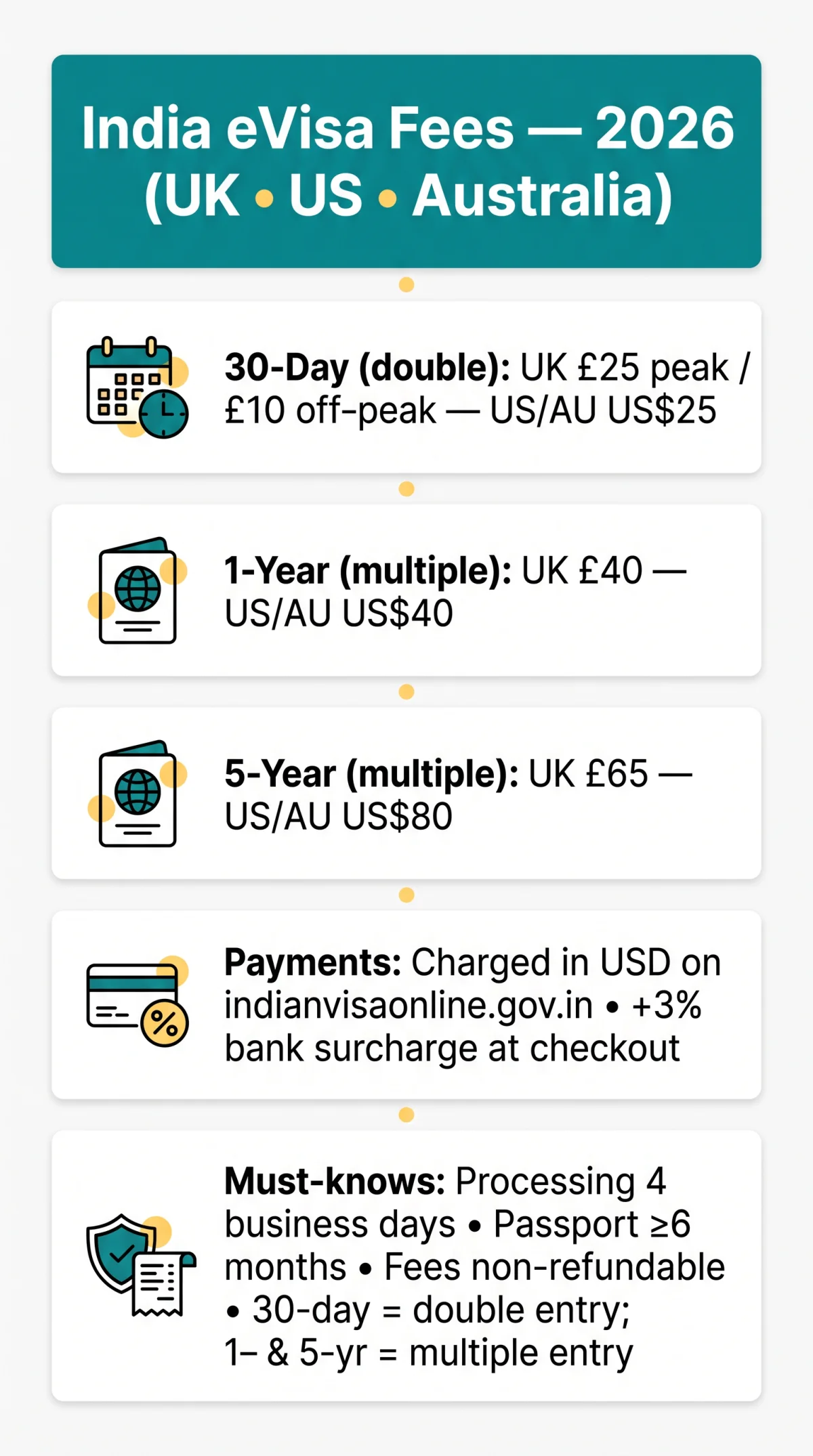
| Tier | Validity | Entry Type | UK Fee | US Fee | Australia Fee | +3% Surcharge |
|---|---|---|---|---|---|---|
| Peak (Jul-Mar) | 30 days | Double | £25 | US$25 | US$25 | Yes |
| Off-Peak (Apr-Jun) | 30 days | Double | £10 | US$10 | US$10 | Yes |
| Standard | 1 year | Multiple | £40 | US$40 | US$40 | Yes |
| Extended | 5 years | Multiple | £65 | US$80 | US$80 | Yes |
The authorised application portal (indianvisaonline.gov.in) charges in USD; GBP figures are UK High Commission equivalents confirmed in April 2026. The eVisa India fee breakdown above shows US and Australian citizens pay identical rates, while UK nationals benefit from lower GBP-denominated charges on 1-year and 5-year options. The 3% bank surcharge applies automatically, and every India eVisa fee is non-refundable regardless of application outcome. This eVisa India fee structure reflects bilateral reciprocity agreements, not a flat global rate.
Seasonal Pricing, Bank Surcharges and Refund Policy
The eVisa India fee breakdown shows the 30-day e-Tourist Visa costs US$25 during peak season (July-March) but drops to US$10 off-peak (April-June), a 60% reduction confirmed by the Consulate General of India, San Francisco (cgisf.gov.in). A 3% bank gateway surcharge applies automatically at checkout on indianvisaonline.gov.in, confirmed by three institutional sources. For a UK card paying the 1-year India eVisa fee: US$40 × 1.03 = US$41.20, converted at approximately £1 = $1.27 (as of 1 June 2026), yielding £32.44 total. An Australian cardholder faces the same US$41.20, converted at roughly A$1 = $0.65, resulting in A$63.38. Exchange rates fluctuate daily; these GBP and AUD amounts are indicative only. All India eVisa fees are non-refundable regardless of whether the application is approved, rejected, or withdrawn.
Which eVisa Tier Offers the Best Value for UK, US and Australian Travellers?
Two or more trips per year? The 1-year eVisa India saves money; three or more? The 5-year tier is best.
The India eVisa fee breakdown reveals clear cost-per-trip advantages at higher validity tiers. Two peak-season 30-day eVisas cost US$50 + 3% surcharge = US$51.50, whereas a 1-year multiple-entry eVisa totals US$40 + 3% = US$41.20, a saving of US$10.30. For UK citizens, two 30-day visas at £25 each total £50 versus the 1-year fee of £40, yielding £10+ in savings. At the 5-year tier, four peak 30-day eVisas cost US$100 + 3% surcharge compared with the 5-year eVisa at US$80 + 3% = US$82.40, saving US$20.60. The break-even rule: one trip per year favours the 30-day visa, two or more favour the 1-year option, and three or more over two years make the 5-year tier optimal. UK citizens on 1-year and 5-year India eVisas may stay up to 180 days per visit, maximising value beyond the fee alone.
How to Pay the India eVisa Fee and Avoid Unauthorised Agents
The India eVisa portal accepts Visa and MasterCard credit or debit cards, charges all fees in US dollars, and adds a 3% bank gateway surcharge at checkout.

Payments on the authorised portal (indianvisaonline.gov.in) are processed in USD. The Government of India does not authorise any agent or intermediary to collect eVisa fees; third-party agencies may charge independent service fees separate from the statutory government fee structure.
- Accepts Visa and MasterCard credit or debit cards
- Processing time is 4 business days from submission
- Adds a 3% bank gateway surcharge at checkout
- UK and Australian cardholders incur bank’s FX conversion rate
- No cash or bank transfer options accepted
- All fees are non-refundable regardless of application outcome
Before paying, confirm your passport scan meets the PDF format requirement, your photo is in JPEG format, and your passport has at least 6 months validity from arrival.
India eVisa Fee Breakdown FAQ
This FAQ addresses common questions about India eVisa fees, including the eVisa India refund policy, children’s fees, and gratis nationalities.
Is the India eVisa fee refundable if my application is rejected?
No. All government eVisa fees are non-refundable regardless of approval, rejection, or withdrawal.
Do children and infants need to pay the full eVisa fee?
Yes. Every applicant requires a separate eVisa regardless of age, with no discounted rates for minors.
Which nationalities get a free (gratis) India eVisa?
Citizens of Argentina, Brazil, Fiji, Indonesia, Jamaica, Mauritius, and South Africa pay US$0 government fee, with only the 3% bank surcharge applied at checkout.
What happens if I overstay my India eVisa?
Overstaying may result in financial fines, detention, a ban on future visa applications, and additional exit permit fees.
Can I apply for a new eVisa before my current one expires?
Yes, but you will pay the full statutory fee again with no discounted renewal rate available.
Is the e-Arrival Card included in the eVisa fee?
No. The e-Arrival Card is a separate, free document that must be submitted within 72 hours before arrival via indianvisaonline.gov.in/earrival/, boi.gov.in, or the Indian Visa Su-Swagatam Mobile App.
What is the minimum passport validity required for an India eVisa?
Your passport must have at least 6 months validity from your date of arrival in India, with a digital copy in PDF format required.
How long does it take to process an India eVisa?
The processing time is 4 business days from submission.
Are there different entry types for the 30-day, 1-year, and 5-year eVisas?
Yes. The 30-day e-Tourist Visa permits double entry, while the 1-year and 5-year tiers both permit multiple entry.