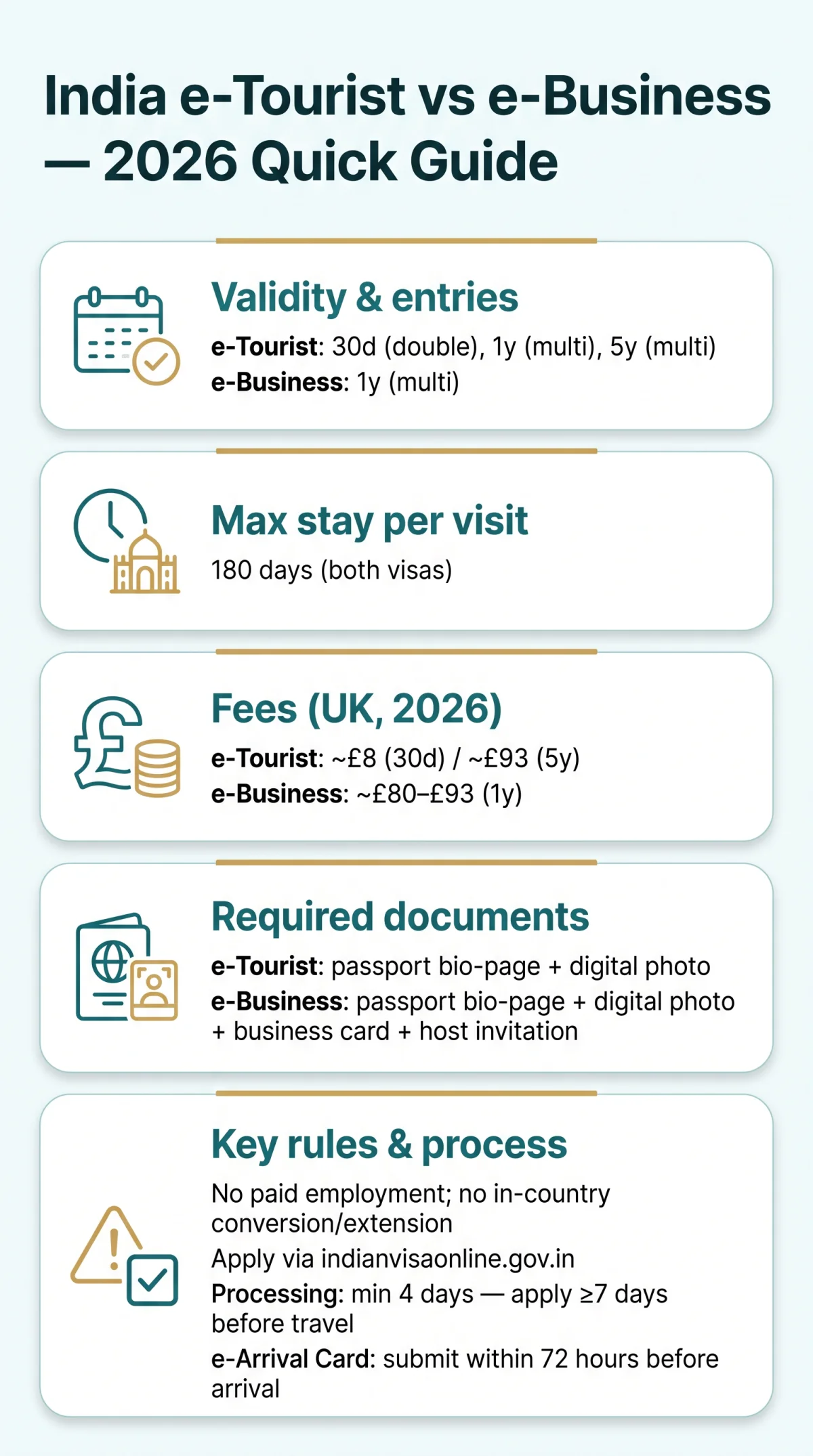
India offers five eVisa sub-categories for UK travellers in 2026: e-Tourist, e-Business, e-Medical, e-Medical Attendant, and e-Conference. The India e-tourist visa vs e-business visa comparison centres on purpose: the e-Tourist covers leisure and sightseeing, while the e-Business permits commercial meetings, sourcing, and trade fairs. Neither authorises paid employment. The e-Tourist visa offers 30 days (double entry), 1 year, or 5 years (both multiple entry). The e-Business visa grants 1-year multiple entry. Maximum continuous stay for UK nationals is 180 days per visit. The Bureau of Immigration issues all eVisas through indianvisaonline.gov.in; no agent or third party is authorised to charge fees. Applications require at least 4 days before arrival. No e-Student visa exists; full-time degree programmes require a paper Student Visa through an Indian Mission or Post.
India e-Tourist Visa vs e-Business Visa: Core Differences
| Parameter | India e-Tourist Visa | India e-Business Visa |
|---|---|---|
| Validity | 30 days / 1 year / 5 years | 1 year |
| Entries | Double (30-day), Multiple (1 & 5-year) | Multiple |
| Max stay per visit | 180 days | 180 days |
| Fee (UK, 2026) | ~£8-£93 | ~£80-£93 |
| Documents | Passport bio-page, digital photo | Passport bio-page, digital photo, business card, host company invitation |
| Employment allowed | No | No |
| Convertible in India | No | No |
The India e-Tourist Visa and India e-Business Visa share a 180-day maximum stay ceiling and a blanket prohibition on paid employment, but diverge sharply in scope and documentation. The India e-Tourist Visa requires only a passport bio-page scan and a digital photograph, making it the simplest application path. The India e-Business Visa adds two mandatory documents: a business card and an invitation letter from an Indian host company. The e-Tourist offers three validity tiers (30-day double entry, 1-year multiple entry, 5-year multiple entry), while the e-Business grants a single 1-year multiple-entry window. For UK nationals, the e-Tourist 30-day option is the cheapest at approximately £8; the e-Business sits at the upper fee band of £80-£93. Neither visa can be converted or extended while the holder remains in India.
Verdict: Choose the India e-Tourist Visa for leisure, family visits, and short-term yoga. Choose the India e-Business Visa for meetings, negotiations, sourcing, trade fairs, and setting up a venture. If your trip combines sightseeing with business meetings, the e-Business visa covers both purposes.
What You Can and Can’t Do on Each eVisa Sub-Type
No eVisa sub-type authorises paid work or local employment in India. The India e-Tourist Visa permits sightseeing, visiting family and friends, recreation, and short-term yoga courses. The India e-Business Visa allows business meetings, negotiations, sourcing, trade fairs, and setting up an industrial or business venture. The India e-Tourist Visa strictly prohibits commercial activities, while the India e-Business Visa strictly prohibits earning local income. EVisas cannot be converted or extended in-country.
| Activity | e-Tourist | e-Business | e-Medical | e-Conference |
|---|---|---|---|---|
| Sightseeing & tourism | Yes | Yes | No | No |
| Business meetings | No | Yes | No | No |
| Trade fairs | No | Yes | No | No |
| Medical treatment | No | No | Yes | No |
| Conference attendance | No | Yes | No | Yes |
| Paid employment | No | No | No | No |
| Short-term yoga | Yes | No | No | No |
Real-world scenarios: A UK delegate attending a Mumbai trade fair must hold an e-Business visa, not an e-Tourist. A traveller combining sightseeing with business meetings should choose the e-Business visa, as it covers both. A patient seeking treatment at an accredited Indian hospital needs an e-Medical visa with triple entry over 60 days. An academic attending a seminar requires an e-Conference visa with prior MEA and MHA political clearance. No India eVisa permits volunteering for paid work or entering the Indian labour market.
eVisa Fees and Application Process for UK Citizens in 2026
UK citizens pay non-refundable India eVisa government fees ranging from approximately £8 to £93 via indianvisaonline.gov.in in 2026.

| eVisa Sub-Type | Validity | Entries | Approx. Fee (UK, 2026) |
|---|---|---|---|
| e-Tourist (short) | 30 days | Double | ~£8 |
| e-Tourist (long) | 5 years | Multiple | ~£93 |
| e-Business | 1 year | Multiple | ~£80-£93 |
| e-Medical | 60 days | Triple | ~£25-£30 |
| e-Conference | 30 days | Single | ~£25-£30 |
The India e-Tourist Visa costs approximately £8 (30-day) or £93 (5-year), while the India e-Business Visa charges £80-£93 for 1-year multiple entry. The India eVisa fees for e-Medical and e-Conference are £25-£30 each. All fees are non-refundable and indicative as of September 2026; they vary with INR/GBP exchange rate fluctuations. Confirm current rates at indianvisaonline.gov.in. Processing takes 4 days minimum; apply at least 7 days in advance. Entry is permitted through 32 designated airports and 6 seaports. Visa on Arrival is available only for citizens of Japan, South Korea, and the UAE; UK citizens must use the eVisa system. Travellers must also submit an e-Arrival Card within 72 hours before arrival via boi.gov.in or indianvisaonline.gov.in/earrival/. This is an arrival information form, not a visa, and applies to all foreigners including OCI and eOCI cardholders.
e-Medical Visa – Requirements, Documents & Restrictions
The India e-Medical Visa allows triple entry over 60 days for medical treatment at an accredited Indian hospital. The e-Medical Attendant Visa is available for accompanying persons on the same validity terms. Required documents include a valid passport bio-page, digital photograph, an admission letter from an accredited Indian medical facility, and supporting medical records. The approximate government fee for UK citizens is £25-£30, non-refundable. The India eVisa framework does not permit extension of the e-Medical visa in-country; if further treatment is needed beyond 60 days, the traveller must exit and reapply through an Indian Mission.
- Triple entry accommodates multiple treatment sessions
- Dedicated medical attendant visa for companions
- Lower fee tier than e-Business
- Limited to 60 days
- Treatment restricted to accredited facilities only
- Cannot be extended in-country
- Requires hospital admission letter before application
e-Conference Visa – Requirements, Documents & Restrictions
The India e-Conference Visa permits single entry for 30 days to attend conferences, seminars, and workshops. Unlike other India eVisa sub-categories, it requires MEA (Ministry of External Affairs) and MHA (Ministry of Home Affairs) political clearance before application. Required documents include a valid passport bio-page, digital photograph, an invitation from the organising body, and political clearance documentation. The approximate government fee for UK citizens is £25-£30, non-refundable.
- Straightforward single-purpose visa
- Lower fee tier
- 30-day window sufficient for most conferences
- Single entry only
- Mandatory political clearance adds processing time
- Shortest validity of all eVisa sub-categories
- Cannot be extended or converted in-country
Which eVisa Should I Pick? Decision Guide & Student Visa Myth
Choose e-Tourist for holidays, e-Business for meetings, e-Medical for hospital treatment, and e-Conference for events. No e-Student visa exists. Each India eVisa sub-type serves a distinct purpose, and none can be converted or extended once inside India.
- Solo backpacker or holidaymaker – The India e-Tourist Visa covers leisure travel, visiting family, and short-term yoga. Validity ranges from 30 days to 5 years.
- Business delegate – The India e-Business Visa grants 1-year multiple entry for negotiations, sourcing, and setting up ventures. Requires a business card and an invitation letter from an Indian host company.
- Medical patient – The e-Medical Visa allows triple entry over 60 days at an accredited Indian hospital. An e-Medical Attendant Visa covers companions.
- Conference attendee – The e-Conference Visa permits single entry for 30 days but requires MEA and MHA political clearance before application.
- Combined business and leisure traveller – The India e-Business Visa covers both commercial meetings and sightseeing, making it the correct choice for blended trips where the India e-Tourist Visa would fall short.
- Full-time student – No e-Student visa exists. Apply for a paper Student Visa through an Indian Mission or consulate. The eVisa framework does not cover academic study.
FAQ: Indian eVisa for UK Travellers
What is the difference between India e-Tourist visa and e-Business visa?
The India e-Tourist visa covers leisure: sightseeing, visiting family, recreation, and short-term yoga. It offers 30-day, 1-year, or 5-year validity. The India e-Business visa permits commercial activities: meetings, negotiations, sourcing, trade fairs, and setting up a venture. It grants 1-year multiple entry. Neither allows local employment or earning a salary in India.
Can I do business meetings on an Indian e-Tourist visa?
No. The e-Tourist visa strictly prohibits business meetings, negotiations, sourcing, or any commercial activity. Attending a business meeting on an e-Tourist visa risks denial of entry and visa cancellation. Apply for the e-Business visa through indianvisaonline.gov.in instead.
How much does an Indian eVisa cost for UK citizens in 2026?
Indicative 2026 fees: 30-day e-Tourist ~£8, 5-year e-Tourist ~£93, 1-year e-Business ~£80-£93, e-Medical and e-Conference ~£25-£30 each. All fees are non-refundable and vary with exchange rates. Confirm at indianvisaonline.gov.in.
Is there an Indian e-Student visa?
No. The eVisa system includes only five sub-categories: e-Tourist, e-Business, e-Medical, e-Medical Attendant, and e-Conference. Full-time degree students must apply for a regular paper Student Visa through an Indian Mission or Post.
Can I extend or convert my eVisa while in India?
No. An eVisa cannot be converted to another category or extended beyond its validity while inside India. You must exit and reapply through an Indian Mission. For e-Business holders exceeding 180 days, FRRO registration is required.
Do I need to fill out anything else besides my eVisa before travelling?
Yes. All foreign nationals must submit an e-Arrival Card within 72 hours before arrival via boi.gov.in or indianvisaonline.gov.in/earrival/. This is a separate arrival information form, not a visa, and applies to all foreigners including OCI and eOCI cardholders.
Can I use a different passport to enter India than the one on my eVisa?
No. The passport used for travel must match the passport on the Electronic Travel Authorisation (ETA). A mismatch results in denied boarding or entry. If your passport has been renewed, apply for a new eVisa before travelling.
Can I use a third-party agent to apply for my Indian eVisa?
No. No agent, intermediary, or third party is authorised to charge fees for eVisa processing. The sole application platform is indianvisaonline.gov.in, operated by the Bureau of Immigration. Using third-party services risks delays, rejected applications, and additional costs.
Which Indian airports accept eVisa holders?
Entry is permitted through 32 designated airports (including Delhi, Mumbai, Chennai, Kolkata, Bengaluru, and Hyderabad) and 6 designated seaports. Check the full list at indianvisaonline.gov.in before booking flights.
How long does eVisa processing take for UK applicants?
Processing takes a minimum of 4 days from application before the date of arrival. Apply at least 7 days in advance to allow for unforeseen delays. The Bureau of Immigration issues all eVisas through indianvisaonline.gov.in.
Published: September 2026. Last reviewed: 09 September 2026. This portal is an independent information resource and is not affiliated with the Government of India, the Bureau of Immigration, or any Indian mission. We do not charge fees for visa processing. Apply only through indianvisaonline.gov.in.