
Last updated: 9 September 2026. This article reflects the current e-Medical visa rules for UK citizens.
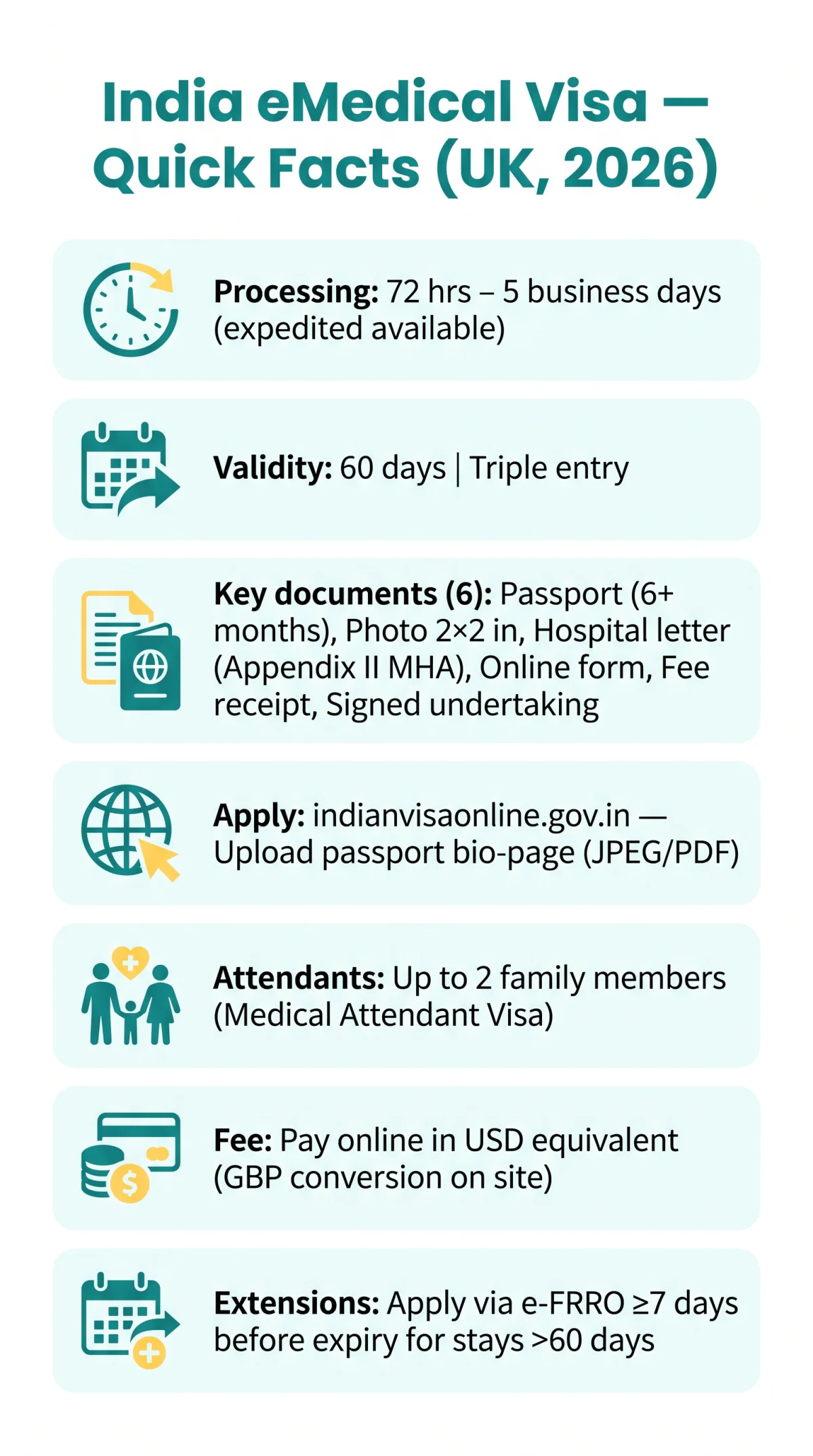
To apply for an India eMedical visa in 2026, UK citizens need a valid passport (6+ months), a hospital invitation letter in Appendix II MHA format, and a completed online application at indianvisaonline.gov.in. Standard processing takes 72 hours to 5 business days; expedited options exist for emergency medical travel.
What Is an eMedical Visa for India?
The India eMedical Visa is an electronic visa granting foreign nationals a 60-day validity with triple-entry access for genuine medical treatment at recognised Indian hospitals. The eMedical Visa covers allopathic treatment, AYUSH therapies, organ transplants, oncology, and major surgeries. It does not cover wellness tourism, cosmetic procedures, or dental tourism without medical justification. Up to two family members may accompany the patient on a linked Medical Attendant Visa. The eTourist visa does not permit medical treatment.
Documents Required for an Indian eMedical Visa in 2026
Six core eVisa India medical visa documents are required: a valid passport, passport photo, hospital invitation letter, completed online application, visa fee receipt, and signed undertaking declaration.
- Valid passport: minimum 6 months validity from date of arrival, with at least two blank pages
- Passport-size photograph: 2×2 inches, white background, full face, no sunglasses or head coverings (religious exceptions apply)
- Hospital invitation letter: issued by a recognised Indian hospital in Appendix II MHA format
- Medical diagnosis or treatment summary: from your home-country physician supporting the treatment purpose
- Completed eVisa application form: submitted online at indianvisaonline.gov.in
- Visa fee payment receipt: payable online only
- Signed undertaking: self-declaration form confirming the genuine medical treatment purpose
Also upload a passport bio-page scan in JPEG or PDF format for the eMedical Visa. Ensure the scan is legible and meets the portal file-size limits before submission.
Passport and Photo Specifications
The eMedical Visa bio-page scan must be JPEG or PDF under the portal maximum file size. The photograph must be 2×2 inches on a white background, recent, full face, no sunglasses or head coverings unless religious. UK applicants should ensure the photo meets Indian consular photo requirements, not UK passport photo standards.
Visa Fee – What UK Applicants Will Pay in 2026
The eMedical Visa fee is payable online in USD equivalent with GBP conversion, as listed on indianvisaonline.gov.in at the time of application. The Government of India does not authorise any agent or intermediaries to charge additional fees for emergency, express visa, eVisas or eArrival card. No separate emergency surcharge exists.
Hospital Invitation Letter: Format, Requirements and Downloadable Template
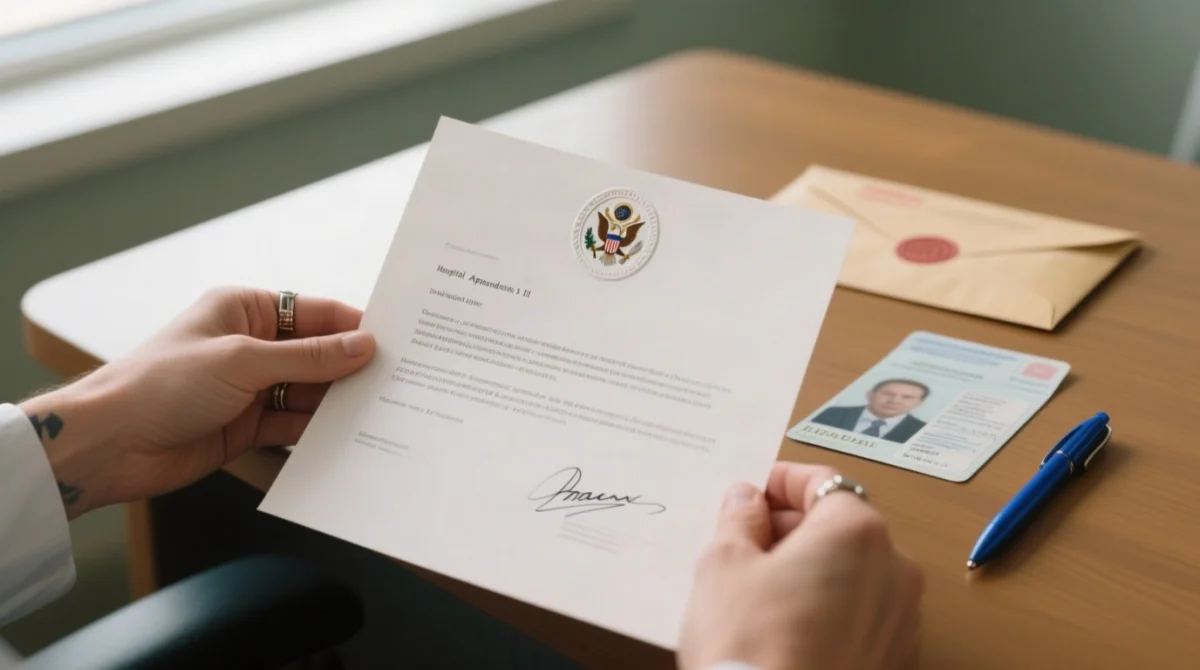
The hospital invitation letter in official Appendix II MHA format is the single most critical eMedical Visa document, requiring patient name, passport number, diagnosis, treatment plan, and hospital seal.
| Required Field | What to Include |
|---|---|
| Patient full name | Exactly as shown on passport |
| Passport number | Matching the applicant’s travel document |
| Diagnosis | Medical condition requiring treatment in India |
| Proposed treatment plan | Procedure details and estimated duration |
| Hospital name and registration number | Accredited institution details |
| Treating doctor | Name, registration number, and signature |
| Hospital seal and date of issue | Official stamp on letterhead |
How to Obtain a Hospital Letter from an Indian Hospital
Contact the recognised Indian hospital’s international patient department, share your medical records and passport details, and request the letter in Appendix II MHA format. Verify every field matches your passport before uploading the signed document to your eMedical Visa application.
What Treatments Qualify for an eMedical Visa?
The eMedical Visa covers allopathic treatment, AYUSH therapies, organ transplants, oncology, major surgeries, cardiac and orthopaedic procedures. Non-qualifying purposes include cosmetic tourism, wellness retreats, yoga holidays, and dental tourism without medical justification.
| Qualifying | Non-Qualifying |
|---|---|
| Allopathic treatment, AYUSH therapies, organ transplants, oncology, major surgeries, cardiac and orthopaedic procedures | Cosmetic tourism, wellness retreats, yoga holidays, dental tourism without medical justification |
How to Apply for an eMedical Visa Online – Step-by-Step Guide for UK Citizens
UK citizens apply for the eMedical Visa at indianvisaonline.gov.in by completing eight steps: gathering documents, filling the form, uploading files, paying the fee, and downloading the approved ETA.
Gather all eVisa India medical visa documents – passport, photo, hospital letter, and signed undertaking.
Visit indianvisaonline.gov.in and select the eMedical Visa category.
Fill in personal details, passport data, hospital name, and treatment purpose.
Upload the passport bio-page scan, photograph, hospital letter, and undertaking.
Pay the visa fee online in GBP equivalent.
Save the Application ID issued on screen.
Track your eMedical Visa status on the same portal using that ID.
Receive the e-Visa ETA (Electronic Travel Authorization) by email – print and carry it on arrival.
For supplementary guidance, UK applicants can consult the High Commission of India, London or VFS Global centres. Separately, every traveller must submit an e-Arrival Card within 72 hours before arrival via indianvisaonline.gov.in/earrival or the ‘Indian Visa Su-Swagatam’ mobile app.
eMedical Visa Processing Times, Delays and Stay Extensions
Standard eMedical Visa processing takes 72 hours to 5 business days; applicants waiting over 10 days should email the Bureau of Immigration directly. For a broader overview of how long Indian eVisa processing takes, see our dedicated guide.
If processing exceeds 5 business days, check your eMedical Visa status online using your Application ID. If delayed beyond 10 days, email the Bureau of Immigration via indianvisaonline.gov.in. If delayed beyond 15 days, contact the High Commission of India, London. Patients needing more than 60 days must apply for a stay extension via the e-FRRO portal at least 7 days before the eMedical Visa expires, with an updated hospital letter, passport copy, and medical reports. Learn more about the rules for extending an Indian eVisa and overstaying in our separate article.
Emergency Medical Travel – How to Fast-Track Your Visa
Applicants with life-threatening conditions can request expedited eMedical Visa processing by submitting emergency medical reports directly to the Bureau of Immigration or High Commission of India London. Qualifying emergencies include urgent surgery, organ transplant with time-sensitive donor match, and critical cardiac conditions. Required documents: emergency medical report from your treating physician, hospital confirmation of urgency, and passport details.
Medical Attendant Visa for Family Members
Up to two family members can obtain a linked Medical Attendant Visa by submitting passport, photograph, and proof of relationship alongside the patient’s eMedical Visa application.
Attendants must submit a passport with at least six months’ validity, a passport-size photograph, and proof of relationship – such as a marriage or birth certificate – alongside a copy of the patient’s eMedical Visa application. The Medical Attendant Visa validity mirrors the patient’s visa, and attendants cannot seek independent medical treatment on this visa.
Common Mistakes That Cause eMedical Visa Rejection
The top eMedical Visa rejection reasons include incorrect photo format, incomplete hospital letter, expired passport, name mismatches, and uploading unreadable document scans. For more detail on what happens if your Indian eVisa is rejected, read our full guide.
- Incorrect photo format – wrong dimensions, dark background, or sunglasses: re-shoot at 2×2 inches on white background
- Incomplete hospital letter – missing Appendix II MHA fields or doctor’s signature: request the letter in the prescribed format
- Passport validity under 6 months or fewer than two blank pages: renew before applying
- Name mismatch between passport and application form: cross-check every field before submission
- Missing signed undertaking: include the self-declaration form with your eVisa India medical visa documents
- Unreadable or low-resolution scans: re-scan the bio-page at sufficient clarity
- Wrong visa category – selecting eTourist instead of eMedical: confirm the correct category on indianvisaonline.gov.in
Frequently Asked Questions About the India eMedical Visa in 2026
What documents do I need for a medical visa to India from the UK?
Six documents: passport (6+ months validity), photo, hospital invitation letter (Appendix II MHA format), online application form, fee receipt, and signed undertaking.
How long does an eMedical Visa take to process in 2026?
Standard processing is 72 hours to 5 business days; expedited processing is available for emergency medical travel.
What is the hospital invitation letter for an India medical visa?
A letter from a recognised Indian hospital confirming treatment, in Appendix II MHA format, including patient name, passport number, diagnosis, treatment plan, and hospital seal.
Can I apply for an eMedical visa in an emergency?
Yes – submit emergency medical reports to the Bureau of Immigration or High Commission of India London for expedited eMedical Visa processing.
How many times can I enter India on an eMedical visa?
Triple entry within a 60-day validity window, max 60 days per stay. Longer treatment: apply for e-FRRO extension at least 7 days before expiry.
How much does an eMedical visa cost for UK citizens in 2026?
The fee is payable online in USD equivalent with GBP conversion, as listed on indianvisaonline.gov.in. The Government of India does not authorise any agent to charge additional fees for eVisas.
Can family members accompany me on an eMedical visa?
Yes – up to two family members can obtain a linked Medical Attendant Visa with passport, photo, proof of relationship, and a copy of the patient’s application.
What treatments qualify for an Indian medical visa?
Allopathic treatment, AYUSH therapies, organ transplants, oncology, major surgeries, cardiac and orthopaedic procedures. Not cosmetic tourism or wellness retreats.
How do I check my eMedical visa application status?
Track your eMedical Visa status at indianvisaonline.gov.in using your Application ID. If delayed over 10 days, email the Bureau of Immigration.
What happens if my eMedical visa is rejected?
Reapply with corrected eVisa India medical visa documents, addressing the specific rejection reason – common issues include incorrect photo, incomplete hospital letter, or name mismatch.
Disclaimer: This article is for informational purposes only. Always verify the latest eMedical Visa requirements on indianvisaonline.gov.in before applying.