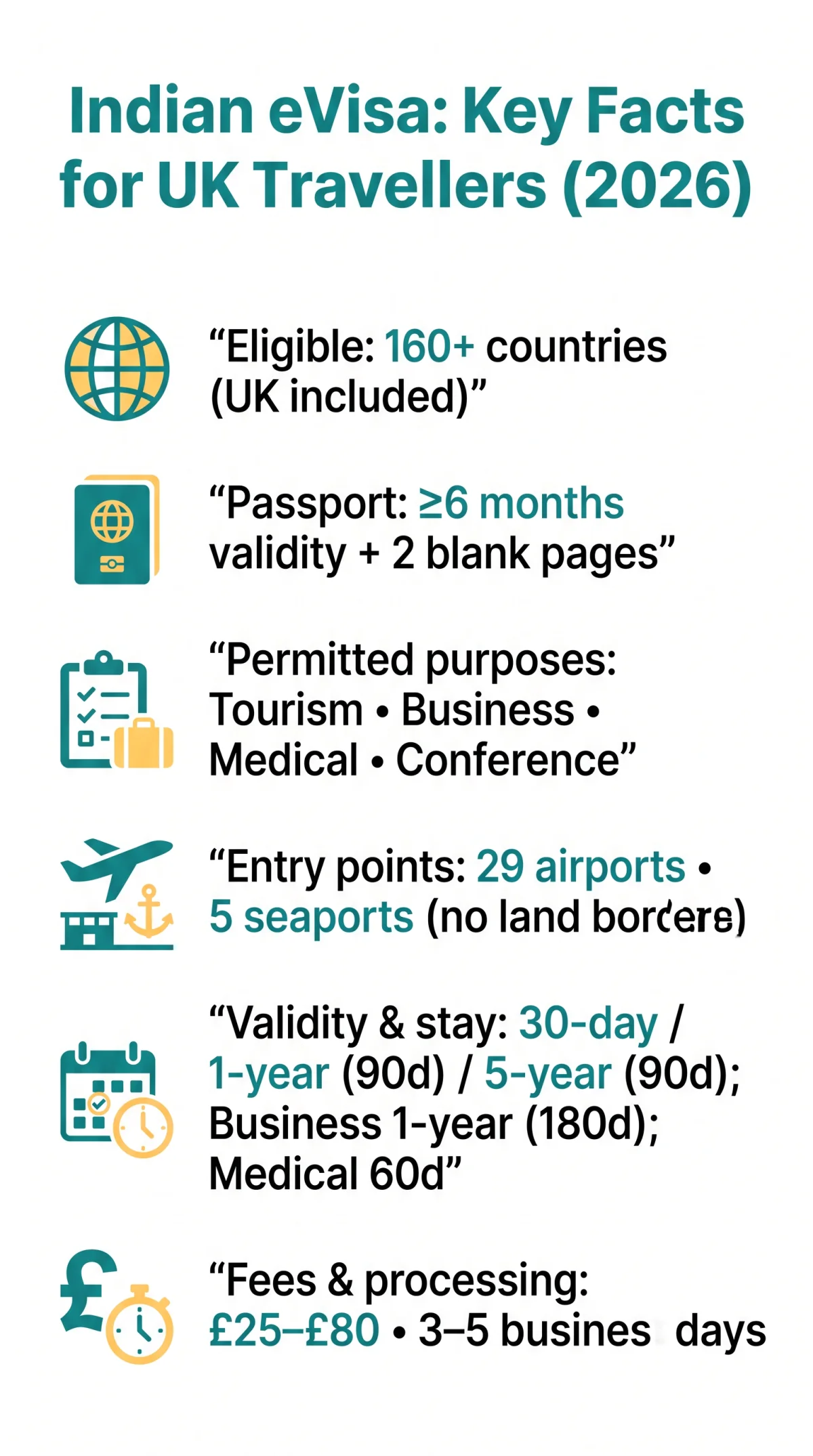
Citizens of over 160 countries, including the UK, are eligible for an Indian eVisa. Applicants must hold a passport valid for at least 6 months with 2 blank pages, travel for an approved purpose (tourism, business, medical, or conference), and enter through a designated port. OCI cardholders are exempt from the visa requirement.
Published: 9 September 2026. Last reviewed: 9 September 2026 against the indianvisaonline.gov.in portal (last published 19 August 2026, Bureau of Immigration, Ministry of Home Affairs) and mha.gov.in (last updated 8 September 2026).
Who Is Eligible for an Indian eVisa? Overview
The Indian eVisa is an electronic visa issued by the Bureau of Immigration, Ministry of Home Affairs, available to citizens of over 160 countries for tourism, business, medical treatment, or conference purposes. In 2026, UK citizens holding a British Citizen passport have full access to all four Indian eVisa categories via the online portal at indianvisaonline.gov.in. Check your nationality against the approved list of 160+ countries (UK is fully eligible) and confirm your travel purpose falls under the limited categories permitted by the Indian eVisa scheme. OCI and eOCI cardholders are exempt from the visa requirement entirely and may enter India with a valid passport and their OCI card. Persons exempted under bilateral arrangements may also enter without an Indian eVisa.
Passport Validity Requirements
An Indian eVisa applicant’s passport must remain valid for at least six months from the planned date of entry into India, not from the application submission date. Additionally, the passport must contain a minimum of two consecutive blank pages for immigration stamps. Both conditions are absolute requirements set by the Bureau of Immigration. Non-compliance leads to denial of boarding or entry, even with an approved Indian eVisa. If your passport expires in fewer than six months from your intended arrival date, renew it before submitting an Indian eVisa application.
Nationality Requirements – Which Countries Are Eligible?
Over 160 nationalities are eligible for an Indian eVisa, with UK citizens holding a British Citizen passport fully accepted across all categories. The complete list of eligible countries is published by the Indian Bureau of Immigration at indianvisaonline.gov.in. Key eligible nations include the UK, USA, Canada, Australia, and most EU member states.
Indian eVisa nationality restrictions exclude several categories. Citizens of Pakistan, persons born in Pakistan, former Pakistani nationals, and individuals whose spouse, parent, or grandparent held Pakistani nationality are not eligible for an Indian eVisa and must apply for a regular/paper visa through an Indian Mission or Post. Holders of diplomatic, official, or UN laissez-passer passports are likewise excluded from the Indian eVisa scheme and must obtain a regular visa. Nationals of the United Arab Emirates may apply for Visa on Arrival at Hyderabad airport, but only if they have previously held an Indian eVisa or regular/paper visa.
Age Requirements and Children
There is no minimum or maximum age limit for an Indian eVisa. Every traveller, including newborns and infants, must hold their own individual passport and a separate Indian eVisa. Parents cannot add children to their passports. A parent or guardian submits the Indian eVisa application on behalf of a minor, but the child’s passport and eVisa are distinct documents linked to the child’s individual passport number.
Permitted Purposes for eVisa
The Indian eVisa covers four limited categories: e-Tourist (recreation, sightseeing, casual visits to friends or relatives), e-Business (meetings, trade), e-Medical (treatment in India), and e-Conference (participation in seminars or government events). Employment, long-term study, journalism, and immigration are excluded from the Indian eVisa scheme. Applying under the wrong category may result in refusal of the Indian eVisa application.
Approved Entry Points for eVisa
Indian eVisa holders must enter through 29 designated airports and 5 seaports. UK travellers most commonly arrive via Delhi (DEL) or Mumbai (BOM). The full list of designated airports includes: Delhi (DEL), Mumbai (BOM), Chennai (MAA), Kolkata (CCU), Bengaluru (BLR), Hyderabad (HYD), Goa (GOI), Jaipur (JAI), Kochi (COK), Ahmedabad (AMD), Amritsar (ATQ), Bagdogra (IXB), Bhubaneshwar (BBI), Calicut (CCJ), Chandigarh (IXL), Coimbatore (CJB), Gaya (GAY), Guwahati (GAU), Kannur (CNN), Lucknow (LKO), Madurai (IXM), Mangalore (IXE), Nagpur (NAG), Port Blair (IXZ), Pune (PNQ), Ranchi (IXR), Thiruvananthapuram (TRV), Tiruchirapalli (TRZ), and Varanasi (VNS). Designated seaports are Mumbai, Goa (Mormugao), Mangalore, Cochin, and Chennai. Land border crossings with Nepal, Bangladesh, Myanmar, and Pakistan do not accept the Indian eVisa. Arriving at an unauthorised entry point results in denied entry.
Passport Photo & Document Requirements
Indian eVisa applicants must upload an ICAO-compliant digital photograph measuring 350×350 pixels against a white background, a standard made mandatory on 1 September 2025 per the Embassy of India, Vilnius. Applicants must also submit a clear colour scan of the passport bio-data page in JPEG or PDF format. File size must not exceed 300 KB per upload. Both files are uploaded during the online Indian eVisa application. Common rejection causes include photos that are too dark, wrong dimensions, or blurry passport scans.
Stay Duration & Validity Windows
Indian eVisas offer 30-day, 1-year, or 5-year validity, with a maximum continuous stay of 90 days per visit for UK citizens on tourist categories. An Indian eVisa cannot be extended or converted while inside India.
| eVisa Type | Validity | Max Continuous Stay | Entries |
|---|---|---|---|
| 30-day Tourist | 30 days from issue | 30 days | Double |
| 1-year Tourist | 1 year | 90 days per visit | Multiple |
| 5-year Tourist | 5 years | 90 days per visit | Multiple |
| 1-year Business | 1 year | 180 days per visit | Multiple |
| Medical | 60 days | 60 days | Triple |
“Continuous stay” means an unbroken period in India. Travellers must leave before the permitted stay expires and re-apply for a new Indian eVisa if needed.
eVisa Fees for UK Citizens
Indian eVisa fees for UK citizens range from approximately £25 for a short-term tourist category to £80 for longer-validity options, payable online via credit or debit card at indianvisaonline.gov.in. The Government of India does not authorise any agent or intermediary to charge fees for emergency, express, or Indian eVisa processing. Any agency claiming faster turnaround for a surcharge operates without government authorisation. Always verify the current fee on the indianvisaonline.gov.in portal before submitting payment.
Processing Time
Standard Indian eVisa processing takes 3 to 5 business days from submission of a complete application. Factors that delay processing include incomplete forms, data errors, and peak season (October to March). There is no official express or expedited Indian eVisa pathway. Apply at least 1 to 2 weeks before your departure date.
Entry Requirements Beyond the eVisa
Beyond the Indian eVisa, travellers must present a return or onward ticket, sufficient funds, and a mandatory e-Arrival card submitted within 72 hours before arrival.
Return or onward ticket
Proof of departure from India may be requested at immigration.
Proof of funds
Officers may verify sufficient financial means for the duration of stay.
e-Arrival card
Mandatory for all foreign nationals and OCI holders. Submit within 72 hours before arrival via indianvisaonline.gov.in/earrival/ or the Indian Visa Su-Swagatam Mobile App. This is arrival information, not a visa.
Self-Declaration Form
All passengers must submit this before reaching Arrival Immigration Counters at airsuvidha.civilaviation.gov.in.
Biometric enrolment
Fingerprints and a facial photograph are taken at immigration control upon landing in India.
This article is for informational purposes only. Visa regulations change frequently. Always verify current requirements on the official indianvisaonline.gov.in portal before applying. We are not affiliated with any government agency.
FAQ
What are the passport validity requirements for an Indian eVisa?
Your passport must be valid for at least 6 months from entry and have at least 2 consecutive blank pages. Non-compliance leads to denial of boarding or entry, even with an approved Indian eVisa.
Which nationalities are eligible for an Indian eVisa?
Citizens of over 160 countries, including the UK, USA, Canada, Australia, and most EU nations. Citizens of Pakistan and persons born in Pakistan are not eligible. The full list is on indianvisaonline.gov.in.
Are there age restrictions for an Indian eVisa?
No minimum or maximum age applies. Every traveller, including newborns, must hold their own passport and a separate Indian eVisa. A parent or guardian submits the application on behalf of a minor.
Can I apply with a diplomatic or official passport?
No. The Indian eVisa is available exclusively for ordinary passport holders. Diplomatic, official, service, or UN laissez-passer holders must apply for a regular/paper visa through an Indian Mission or Post.
How much is an Indian eVisa for UK citizens?
Fees range from approximately £25 to £80 depending on visa type. Always check the latest fee on indianvisaonline.gov.in. The Government of India does not authorise agents to charge additional express fees.
How long does it take to get an Indian eVisa?
Standard processing takes 3 to 5 business days. There is no official express option. Apply at least 1 to 2 weeks before your departure date.
What is the e-Arrival card and do I need it?
Yes. The e-Arrival card is mandatory arrival information that all travellers, including OCI holders, must submit online within 72 hours before arriving in India via indianvisaonline.gov.in/earrival/ or the Su-Swagatam app. It is not a visa.
Can I extend my Indian eVisa while in India?
No. An Indian eVisa cannot be extended or converted while in India. You must leave before the permitted stay expires and re-apply for a new Indian eVisa if needed.
Can I enter India on a new passport if my eVisa was issued on the old one?
Yes. You may be allowed entry on a new passport even if the Indian eVisa (ETA) was issued on the old passport, provided you carry both passports. Confirmed by the High Commission of India, London (hcilondon.gov.in).
Can UAE nationals get Visa on Arrival in India?
Yes, but only UAE nationals who have previously obtained an Indian eVisa or regular/paper visa. Visa on Arrival is available exclusively at Hyderabad airport.