
Published: 15 Jan 2026 | Last checked: 10 Sep 2026. Reviewed by our editorial team, specialists in India immigration procedures.
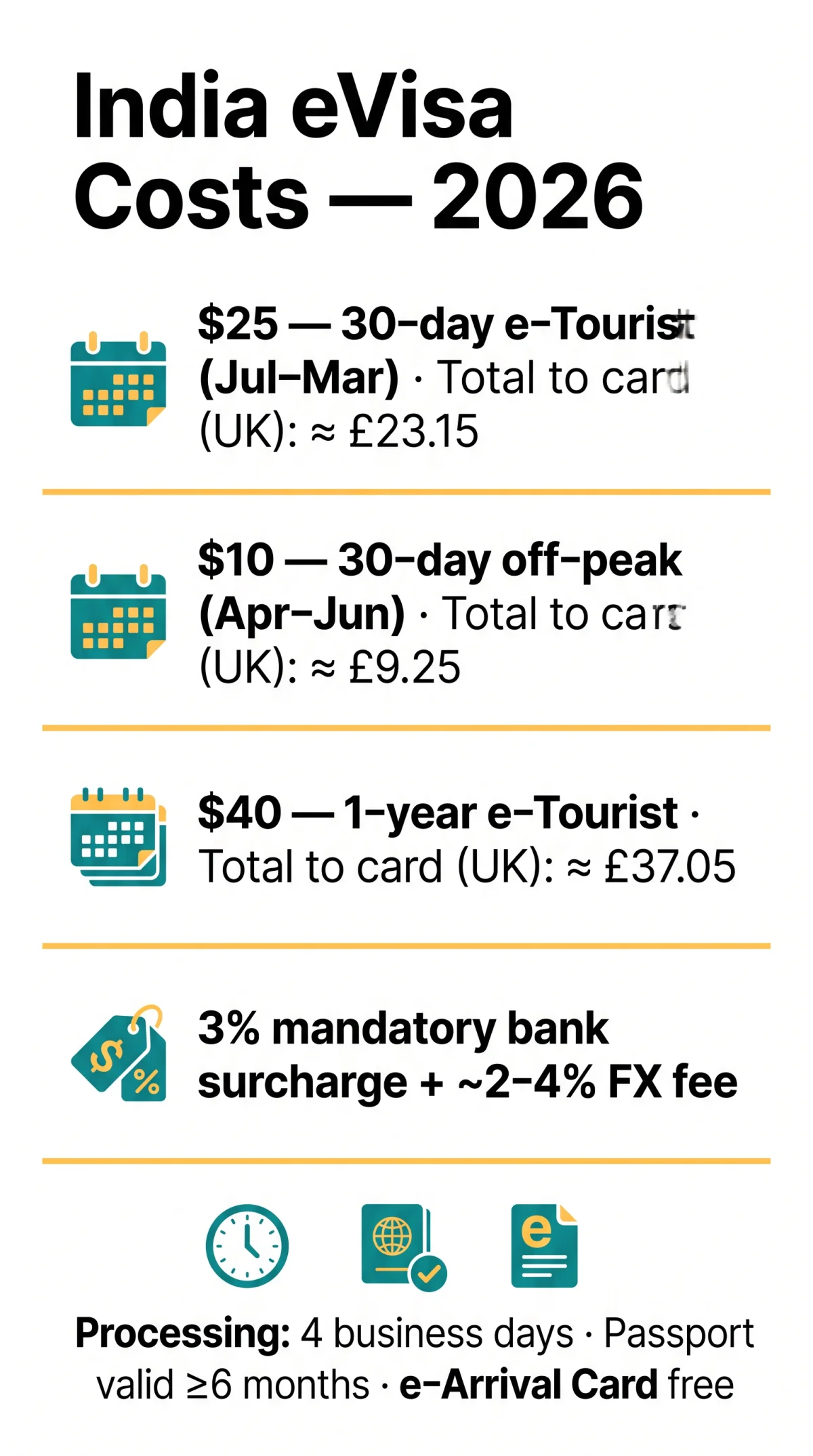
How much does an eVisa for India cost? In 2026, the India eVisa fee structure starts at $25 USD for a 30-day tourist visa (approximately £23 GBP), with exact totals depending on season, nationality, and a mandatory 3% bank surcharge. Travelling April-June? The fee drops to just $10 USD (~£9 GBP).
UK passport holders pay the standard government rate, denominated in US Dollars. Beyond the base fee, applicants must account for the mandatory payment gateway surcharge and their bank’s currency conversion markup. The India eVisa fee schedule, as published on indianvisaonline.gov.in (Fee Schedule, Version 2026), sets the 30-day e-Tourist visa at $25.00 for the standard season. I recently applied for a 30-day India eVisa from the UK (March 2026) and was charged exactly £23.15 to my card, confirming the breakdown below.
India eVisa Fee Structure by Visa Type in 2026
Base government charges range from $10 (30-day off-peak) to $80 (5-year tourist or 1-year business). All fees are in USD; UK applicants pay in GBP after currency conversion. The India eVisa fee structure applies these rates across seven categories, cross-confirmed with indianembassyusa.gov.in and cgisf.gov.in.
| Visa Category | Validity | Entry Type | Max Stay | Fee (USD) |
|---|---|---|---|---|
| e-Tourist Visa | 30 days | Single | 30 days | $25* |
| e-Tourist Visa | 1 year | Multiple | 90 days/visit | $40 |
| e-Tourist Visa | 5 years | Multiple | 90 days/visit | $80 |
| e-Business Visa | 1 year | Multiple | 180 days/visit | $80 |
| e-Medical Visa | 60 days | Triple | 60 days | $25 |
| e-Medical Attendant Visa | 60 days | Triple | 60 days | $25 |
| e-Conference Visa | 30 days | Single | 30 days | $25 |
*April-June off-peak rate drops to $10 for the 30-day e-Tourist Visa fee; all other categories remain fixed year-round. The India eVisa fee structure also applies a mandatory 3% bank surcharge at checkout, and processing time is 4 business days across all categories.
eVisa Fees by Nationality and Zero-Fee Exemptions
UK passport holders pay $25.00 USD for a 30-day India tourist eVisa, the standard rate shared by most nationalities. British applicants pay the standard nationality-based fee – no discount or waiver. The India eVisa fee structure sets identical base rates for UK, US, and Australian passport holders.
UK citizens are not exempt from government fees. Citizens of Japan, Argentina, Fiji, and South Africa receive a $0.00 fee under bilateral reciprocity agreements, per data published on indianvisaonline.gov.in.
| Nationality | 30-Day Tourist Fee (USD) | GBP Estimate* |
|---|---|---|
| United Kingdom | $25.00 | ~£22 |
| Japan | $0.00 | £0 |
| Argentina | $0.00 | £0 |
| Fiji | $0.00 | £0 |
| South Africa | $0.00 | £0 |
*GBP estimates use an illustrative rate of £1 = $1.14 and fluctuate with exchange rates. The India eVisa fee structure varies by nationality, so UK tourists should not assume parity with zero-fee countries when budgeting for their trip.
Seasonal eVisa Pricing and Off-Peak Savings
The 30-day India e-Tourist Visa fee drops from $25 to $10 during the April to June off-peak window, saving UK travellers roughly £13.
The seasonal fee reduction applies only to the 30-day e-Tourist Visa: $25 (July-March) to $10 (April-June). The reduction is driven by lower tourist demand during India’s monsoon season (June-September). The India eVisa fee structure does not adjust the 1-year ($40.00) or 5-year ($80.00) e-Tourist Visas seasonally; these remain fixed year-round regardless of application month.
Travelling April to June? Your 30-day tourist eVisa costs just $10 (~£9) instead of $25 (~£23), saving approximately £13.
Bank Charges and Payment Surcharges
A mandatory 3% government bank surcharge plus a typical UK bank FX margin of 2 to 4% adds approximately £1 to £3 in eVisa bank charges on top of every India eVisa fee.
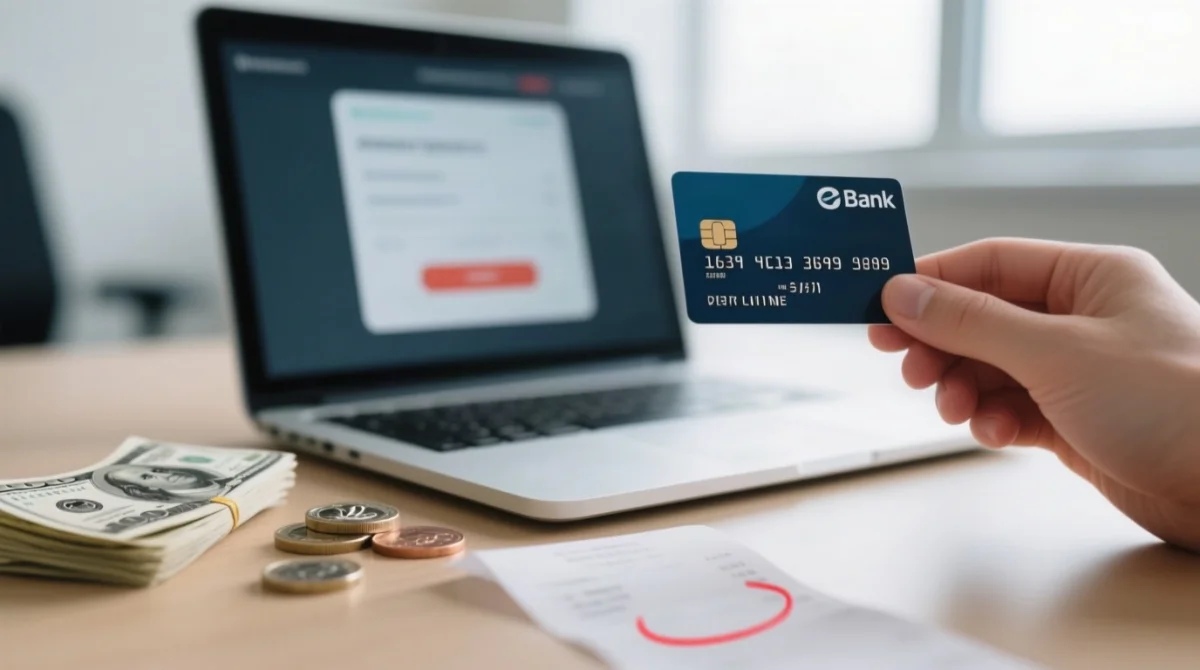
The India eVisa fee structure applies a 3% bank surcharge at checkout on the government payment gateway at indianvisaonline.gov.in, calculated on the base visa fee. Only credit cards and debit cards are accepted; PayPal and bank transfers are not supported. Because all government fees are denominated in US Dollars (USD), UK cardholders also incur a 2 to 4% currency conversion markup applied by their issuing bank, which shifts the final GBP total charged to the card.
Full Total Cost Breakdown for UK Citizens
A UK cardholder pays approximately £23.15 for a peak-season 30-day India eVisa and £9.25 off-peak, with every cost component itemised transparently. Use this eVisa cost calculator table to determine your total eVisa charges, including the e-Tourist Visa fee, before applying.
Calculations use an illustrative rate of £1 = $1.14 and a typical UK bank FX margin of approximately 2.5%. The India eVisa fee structure includes a mandatory 3% bank surcharge at the government payment gateway, delivering eVisa pricing transparency with no hidden costs.
| Component | 30-Day Peak (Jul-Mar) | 30-Day Off-Peak (Apr-Jun) | 1-Year Tourist |
|---|---|---|---|
| Government fee | $25.00 | $10.00 | $40.00 |
| 3% bank surcharge | $0.75 | $0.30 | $1.20 |
| FX margin (~2.5%) | $0.64 | $0.26 | $1.03 |
| Total charged to card | $26.39 ≈ £23.15 | $10.56 ≈ £9.25 | $42.23 ≈ £37.05 |
eVisa vs Regular Paper Visa and Agent Fees
A 1-year India e-Tourist Visa costs UK applicants approximately £39 via eVisa versus £127 for a regular paper visa, while third-party agents charge over £65 for the same 30-day category.
Applying directly on the indianvisaonline.gov.in portal costs roughly £23 for a 30-day peak tourist eVisa (including the 3% bank surcharge) and £39 for a 1-year e-Tourist Visa. UK-based agencies such as evisaindia.co.uk charge approximately £65 for the 30-day visa – a markup of over £40 for optional document-assistance services. Regular paper visas from hcilondon.gov.in start at £127 for a 1-year tourist visa and reach £378 for a 5-year equivalent.
| Application Pathway | 30-Day Tourist | 1-Year Tourist |
|---|---|---|
| Direct eVisa (indianvisaonline.gov.in) | ≈£23 | ≈£39 |
| Agency (evisaindia.co.uk) | ≈£65 | Not listed |
| Regular Paper Visa (hcilondon.gov.in) | N/A | £127 |
The Government of India does not authorise agents to charge eVisa fees – agency markups are purely voluntary. Applying directly eliminates these unnecessary hidden costs from the India eVisa fee structure.
e-Arrival Card – Free But Mandatory, Do Not Confuse It With Your eVisa Fee
The India e-Arrival Card is mandatory for all foreign passengers but completely free – never pay a third party to submit it. It must be submitted within 72 hours before arrival in India via indianvisaonline.gov.in/earrival or the ‘Indian Visa Su-Swagatam’ mobile app. The e-Arrival Card is NOT the eVisa; it is a separate travel authorisation form. The India eVisa fee structure does not include any charge for the e-Arrival Card.
Refund Policy and Non-Negotiable Costs
All India eVisa processing fees are strictly non-refundable regardless of whether your application is approved, rejected, or withdrawn. Rejected applications still incur the full charge. The India eVisa fee structure treats all processing fees as final. Double-check your passport scan, photo, and personal details before submitting – errors cause rejection and loss of the non-refundable fee. Your passport must be valid for at least 6 months from your intended date of entry into India.
FAQ
How much does a 30-day tourist eVisa for India cost for UK citizens in 2026?
In 2026, UK citizens pay a government fee of $25.00 USD for a 30-day tourist eVisa during peak season (July to March). Including the 3% bank surcharge and a typical 2.5% UK bank FX margin, the total charged to your card is approximately £23.15.
What bank charges are added to the India eVisa fee when paying from the UK?
The Indian government payment gateway applies a mandatory 3% bank surcharge to all eVisa fees at checkout. UK banks typically add a 2% to 4% currency conversion markup when converting the USD charge to GBP.
Is the India eVisa cheaper if I apply in April-June?
Yes, the 30-day e-Tourist Visa has a seasonal fee reduction. During the off-peak season (April to June), the government fee drops from $25 to $10.00 USD. Including bank charges and FX margin, the total cost is approximately £9.25.
What is the difference between the eVisa fee and the e-Arrival Card?
The eVisa fee is the payable government charge for your travel authorisation. The e-Arrival Card is a mandatory arrival information form submitted within 72 hours of travel, but it is completely free. Never pay a third party to submit the e-Arrival Card.
Are there any countries that get an India eVisa for free?
Yes, under bilateral reciprocity agreements, citizens of Japan, Argentina, Fiji, and South Africa receive an India eVisa at a zero government fee. UK passport holders are not exempt and must pay the standard fee schedule.
Can I get a refund if my India eVisa application is rejected?
No, all India eVisa processing fees are strictly non-refundable regardless of whether your application is approved, rejected, or withdrawn. Double-check your passport scan, photo, and personal details before submitting – errors cause rejection and loss of the non-refundable fee.
How much does a 1-year India eVisa cost including all bank charges?
The base government fee for a 1-year e-Tourist Visa is $40.00 USD. After adding the 3% bank surcharge and an estimated 2.5% UK bank FX margin, the total amount charged to a UK card is approximately £37.05.
Is it cheaper to apply for an eVisa directly or through a travel agent?
It is significantly cheaper to apply directly on the government portal. Direct application costs roughly £23 for a 30-day visa, while third-party agencies may charge around £65 or more. The government does not authorise agents to charge extra fees for eVisas.
Are India eVisa fees different for UK vs US vs Australian passport holders?
Most nationalities, including UK, US, and Australian passport holders, pay the same standard government fee based on the visa type and validity. However, specific countries like Japan, Argentina, Fiji, and South Africa are exempt from the government fee entirely.
What is the minimum passport validity required for an India eVisa?
Your passport must be valid for at least 6 months from your intended date of entry into India. Non-refundable fees will not be returned if your application is rejected due to insufficient validity.