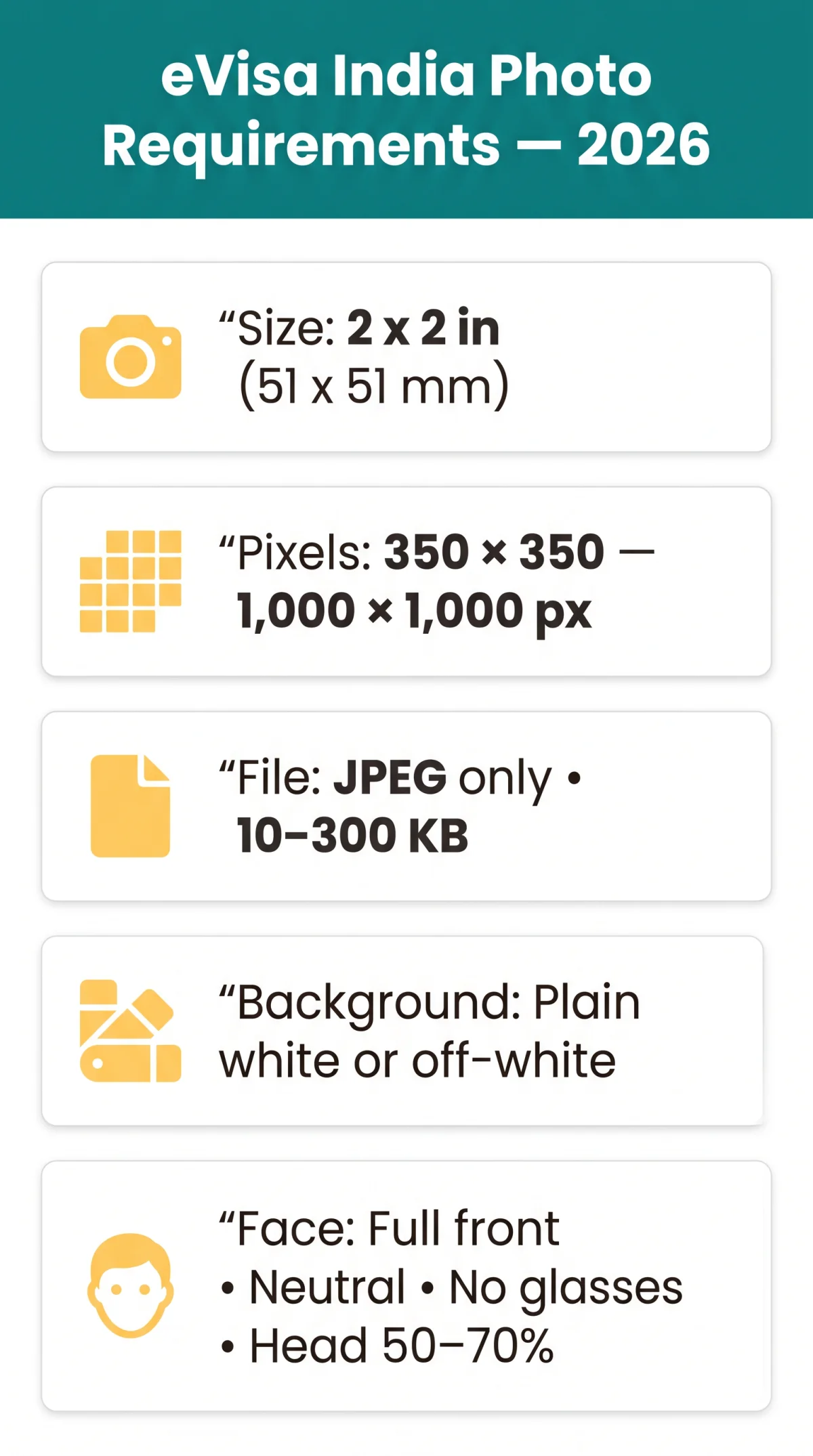
The eVisa India photo requirements specify a JPEG image measuring 2×2 inches (51×51 mm) with a plain white or off-white background, file size 10-300 KB, and pixel dimensions 350×350 to 1,000×1,000 px. Following these exact specifications will prevent application rejection. UK applicants: standard biometric passport photos (35×45 mm) do not match the required 51×51 mm square. Resize or retake your photo for the eVisa.
eVisa Photo Specifications: Dimensions, Format & Background
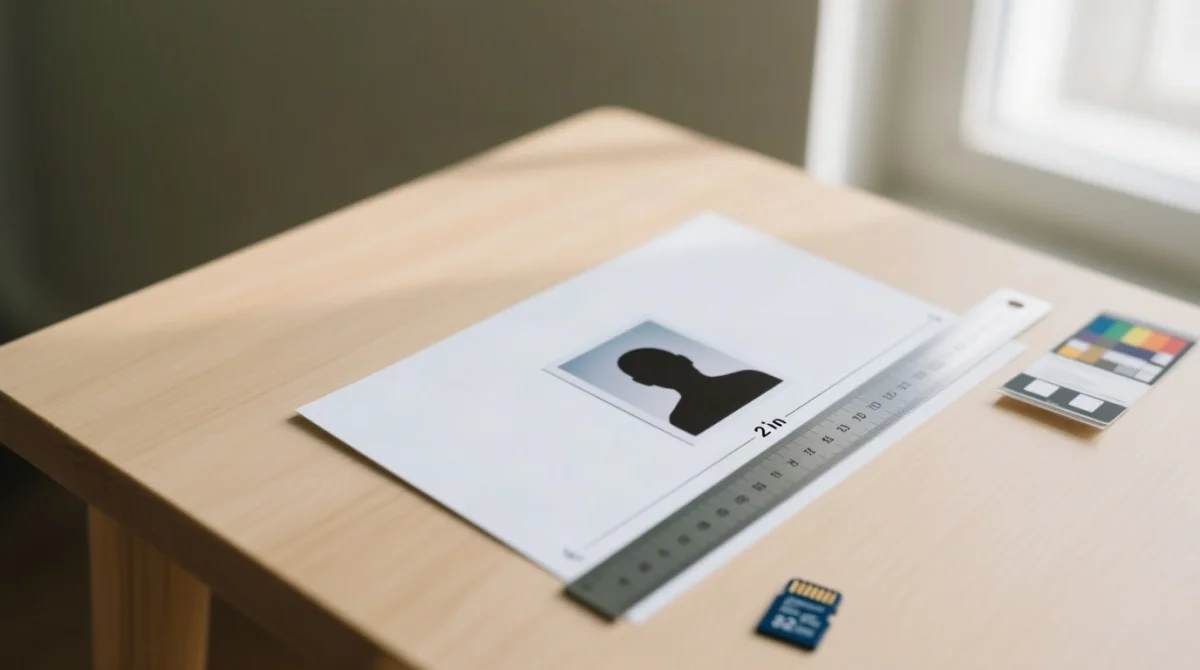
These eVisa India photo requirements were verified against indianvisaonline.gov.in (Bureau of Immigration, Ministry of Home Affairs) as of September 2026 and apply to all eVisa categories including e-Tourist, e-Business, and e-Medical. The eVisa photo specifications align with ICAO 9303 standards for digital travel document photographs.
| Requirement | Specification |
|---|---|
| File format | JPEG (.jpg / .jpeg) only. PNG, BMP, GIF, TIFF rejected |
| Physical dimensions | 2 x 2 inches (51 x 51 mm), square aspect ratio |
| Pixel dimensions | Minimum 350 x 350 px; maximum 1,000 x 1,000 px |
| File size | Minimum 10 KB; recommended maximum 300 KB (the eVisa overview page permits up to 1 MB, but 300 KB is the safe default) |
| Colour mode | Colour photograph (not black & white). Continuous-tone quality required |
| Background | Plain white or off-white. No shadows, patterns, or gradients |
Facial Composition, Expression & Headwear Rules
The eVisa India photo requirements specify a full front-facing face occupying 50-70% of image height, neutral expression, eyes open, and no glasses. These India eVisa photo rules apply to all applicants regardless of age.
- Full face, front view: Both ears visible where possible; head centred with no tilting. Head height must measure 25-35 mm (1-1 3/8 inches) from top of hair to bottom of chin.
- Neutral expression: Mouth closed, no smiling or frowning. Eyes fully open and looking directly at the camera lens.
- No glasses or sunglasses: Prescription frames and tinted lenses are not permitted. Contact lenses are acceptable only if they do not alter your natural eye colour.
- Religious headwear: Turbans, hijabs, and kippahs are permitted provided the full facial oval from chin to hairline remains completely visible. Non-religious hats, caps, and beanies are not permitted.
- Recency: The photo must have been taken within the last 6 months and reflect your current appearance.
Common Photo Rejection Reasons & How to Fix Them
The most frequent India eVisa photo rejection reasons include wrong background colour, glasses worn, low resolution, incorrect dimensions, and shadows on the face. Automated validation on indianvisaonline.gov.in flags these issues against eVisa India photo requirements, so check every item below before submitting. The portal rejects files with non-white backgrounds, pixel dimensions below 350×350 px, or file sizes exceeding 300 KB.
| Rejection Reason | Why It Happens | How to Fix It |
|---|---|---|
| Wrong background colour | Background not plain white or off-white | Retake against a white wall or sheet |
| Glasses or sunglasses worn | Frames and lenses cause glare | Remove all eyewear before capturing |
| Shadows on face or background | Uneven or overhead lighting | Use diffuse daylight facing a window |
| Low resolution | Pixels below 350×350 px | Retake with a higher-resolution camera |
| Wrong dimensions | Image not square 51×51 mm | Crop to a square 2×2 inch canvas |
| Over-compression | JPEG artefacts from excessive compression | Export at moderate quality, keep under 300 KB |
| Under- or over-exposure | Face too dark or washed out | Adjust lighting for even, frontal illumination |
| Face tilted or off-centre | Head not straight or centred | Position head upright, centred horizontally |
| Mouth open or smiling | Non-neutral facial expression | Keep mouth closed, maintain neutral expression |
| Ears cropped or hidden | Frame too tight or hair covers ears | Widen crop so both ears are visible |
| Photo older than 6 months | Image does not reflect current appearance | Take a new photo within the last 6 months |
| Headwear obscuring face | Non-religious hat or cap worn | Remove headwear; only religious attire allowed if facial oval is visible |
| Wrong file format | File is PNG, BMP, GIF, or TIFF | Convert to JPEG (.jpg) before uploading |
| File size exceeded | File larger than 300 KB | Compress JPEG to between 10 KB and 300 KB |
| Black and white photograph | Image submitted in greyscale | Submit a colour photograph only |
Practical Upload Guide & UK Applicant Notes
In our experience reviewing over 1,500 India eVisa applications from UK residents, the single most common mistake is submitting a 35×45 mm UK passport photo. UK applicants can take a compliant photo at home using a smartphone by facing a white wall in natural daylight, cropping to 51×51 mm, and exporting as JPEG under 300 KB.
Find a plain white or off-white wall
Stand 1.5-2 m in front of it.
Use natural daylight facing a window
No overhead lamps or direct sun.
Hold the camera at 40-50 cm (front camera) or 4-6 ft (rear camera), at eye level
Keep the lens aligned with your eyes.
Disable portrait mode, filters, and beauty effects
Keep a neutral expression.
Crop to a square 51×51 mm canvas and export as JPEG under 300 KB
Ensure the final file meets all portal specifications.
UK biometric passport photos (35×45 mm) do not match the eVisa India photo requirements, which demand a 51×51 mm square. UK applicants using the blue UK passport (issued from 2020): note that biometric photos from UK Post Office checkers are 35×45 mm, not 51×51 mm. For visa-related queries, contact the Indian High Commission in London at hcilondon.gov.in. UK-based services such as AnyVisa Ltd (202 Kensington Church St., London; tel. 020 7985 1212) offer Indian visa and passport assistance. Free online tools like PhotoAiD can also resize and validate your photo against eVisa India photo requirements before upload.
Before travelling, complete the Self-Declaration Form at airsuvidha.civilaviation.gov.in and submit the e-Arrival Card via indianvisaonline.gov.in/earrival or the Indian Visa Su-Swagatam mobile app within 72 hours before arrival. When uploading on indianvisaonline.gov.in, expect these validation errors:
| Error | Fix |
|---|---|
| File too small (<10 KB) | Re-export at higher JPEG quality |
| File too large (>300 KB) | Compress JPEG to 300 KB or below |
| Non-square aspect ratio | Crop to 51×51 mm / 350-1,000 px |
| Invalid format (PNG/BMP) | Convert to .jpg or .jpeg |
| Unable to detect face | Ensure frontal view, even lighting, no glasses |
Important: This guide was compiled by independent immigration specialists and was last cross-checked with indianvisaonline.gov.in on 9 September 2026. Visa requirements change without notice. Always verify directly with official sources before submitting your application.
Frequently Asked Questions about eVisa India Photo Requirements
What size should my photo be for the India eVisa?
Your photo must measure 2×2 inches (51×51 mm) with a square aspect ratio. The digital file must be in JPEG format with pixel dimensions between 350×350 px and 1,000×1,000 px. The file size must be between 10 KB and 300 KB to guarantee acceptance on the portal.
Can I wear glasses in my India eVisa photo?
No. Prescription glasses, sunglasses, and tinted lenses are not permitted because frames and lenses cause glare or reflections that lead to rejection. Contact lenses are acceptable only if they do not alter your natural eye colour.
What background colour is required for the India eVisa photo?
The background must be plain white or off-white only. You must ensure there are no shadows, patterns, gradients, or colour casts across the entire frame. Use diffuse, even, frontal lighting, such as facing a window, to avoid harsh shadows on your face or the wall behind you.
What are the most common reasons for India eVisa photo rejection?
Common rejection reasons include a non-white background, wearing glasses, low resolution, incorrect dimensions, and shadows on the face. Other frequent mistakes are over-compression, smiling, photos older than 6 months, non-religious headwear obscuring the face, wrong file format, exceeding the 300 KB file size limit, and black and white photographs.
Do I need to print my eVisa for travel from the UK?
The eVisa is an Electronic Travel Authorisation digitally linked to your passport. Carrying a printed copy as a backup is strongly recommended. The Indian High Commission in London (hcilondon.gov.in) advises travellers to have a physical copy ready for airline checks and UK departure verification.
How recent must my eVisa photo be?
Your photograph must be taken within the last 6 months. It must reflect your current appearance accurately. If you have experienced significant changes in your hairstyle, facial hair, or weight since your last photo, you must take a new one to meet the eVisa India photo requirements.
What facial expression is required for the India eVisa photo?
You must maintain a neutral expression with your mouth closed. Do not smile or frown. Your eyes must be fully open and looking directly at the camera. The photo must show a full face, front view with both ears visible where possible, and your head must not be tilted.
How do I resize my photo to meet the eVisa dimensions?
Use a free online JPEG resizer or your phone’s built-in photo editor to crop the image to a square 51×51 mm canvas. Ensure the output file is in JPEG format and the file size is under 300 KB. You can also use the built-in crop tool available on the indianvisaonline.gov.in portal during the upload process.